




May 15, 2024
Paris – Ulaanbaatar

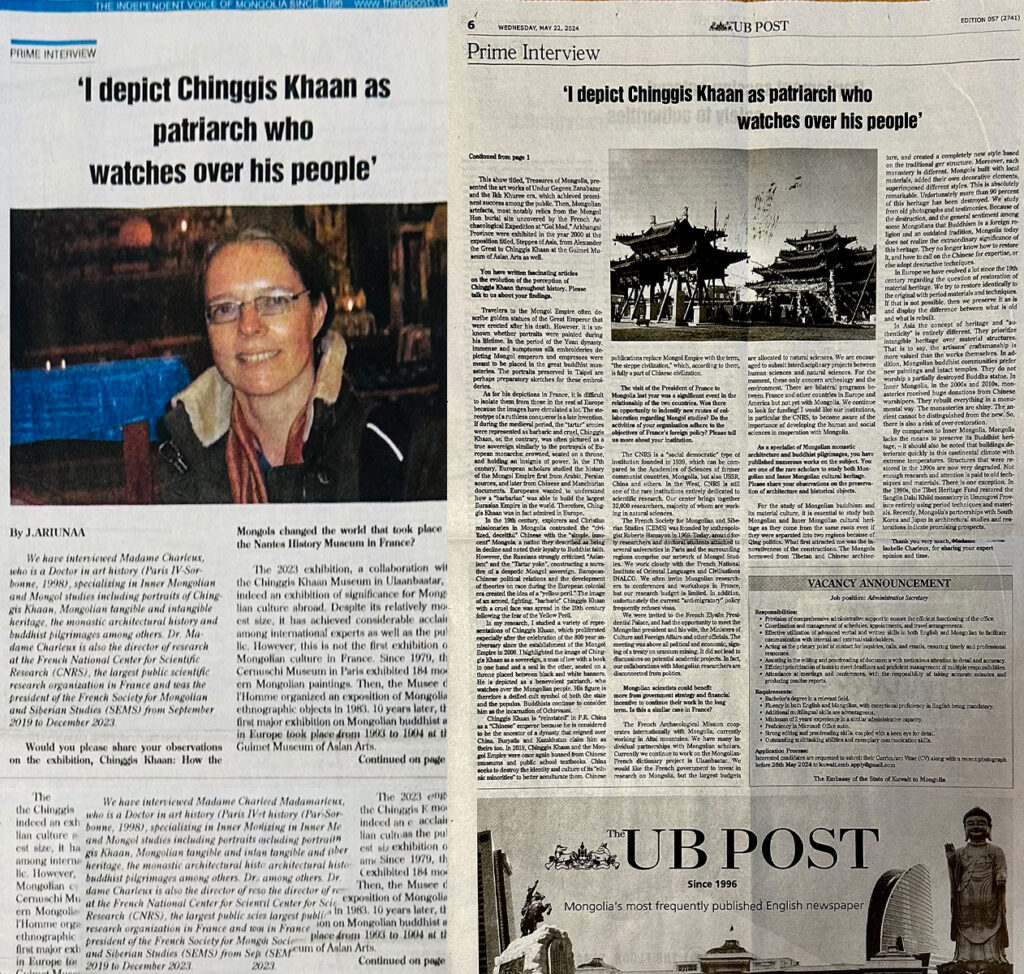
Interview with Madame Isabelle Charleux
Director of Research at the National Centre of Scientific Research (CNRS), France
A.J. : Please allow me to introduce you to our readers. You are a Doctor in art history (Paris IV-Sorbonne, 1998), specializing in Inner Mongolian and Mongol studies including portraits of Chinggis Khaan, Mongolian tangible and intangible heritage, the monastic architectural history, and Buddhist pilgrimages among others. You are the director of research at the French National Center for Scientific Research (CNRS), the largest public scientific research organization in France. You were the president of the French Society for Mongolian and Siberian Studies (SEMS) from September 2019 to December 2023. The SEMS publishes the “Mongol, Siberian, Central Asian and Tibetan Studies” review (EMSCAT) and organizes monthly seminars. Thank you, Madame Charleux, for accepting the invitation to our interview.
Exposition in Nantes, France
A.J. : The Chinggis Khaan Exhibition at the Nantes History Museum took place from October 14, 2023 through May 5, 2024. Anticipated for several years following the Chinese government’s attempted intervention and then the Covid pandemic, it was an event of great importance for Mongolia abroad. According to the official website of the Museum of Château des ducs de Bretagne, “This exhibition is the first in France dedicated to one of the greatest conquerors in History: Genghis Khan. » Would you please share your thoughts?
I.C. : I would like to begin with a brief history of expositions on Mongolian culture in France. Since 1979, the Cernuschi Museum in Paris exhibited 184 modern Mongolian paintings. Then, the Musée de l’Homme organized an exposition of Mongolian ethnographic objects in 1983. Ten years later, the first major exhibition on Mongolian Buddhist art in Europe took place from 1993 to 1994 at the Guimet Museum of Asian Arts. This show titled, Treasures of Mongolia, presented the artworks of Undor Gegeen Zanabazar and the Ikh Khüree era, which achieved prominent success among the public. Then, Mongolian artifacts, most notably relics from the Mongol Hunnu burial site uncovered by the French Archaeological Expedition at “Gol Mod,” Arkhangai Aimag were exhibited in the year 2000 at the exposition titled, Steppes of Asia, from Alexander the Great to Genghis Khan at the Guimet Museum of Asian Arts as well.
The 2023 exhibition, Genghis Khan: How the Mongols changed the world at the Nantes Museum is the result of a collaboration with the Chinggis Khaan Museum in Ulaanbaatar. Marie Favereau, a specialist of the Golden Horde, is the chief scientific commissioner. Together with Jean-Paul Desroches, former curator at the Guimet Museum and director of the French archaeological expedition, as well as Bertrand Guillet, director of the Museum of Dukes of Brittany, they are responsible for the success of this project. The exhibition was inaugurated by a symposium on medieval Mongolian history headed by Ms. Favereau. I presented a lecture on Mongol Studies in France at the conference and wrote an article for the catalog titled, Les Mongols et le monde, 2023. I also contributed with ideas and advice in the early stages of the project in 2020.
It is indeed an exhibition of significance for Mongolian culture abroad. Despite its relatively modest size, it has achieved considerable acclaim among international experts as well as the public. The Association Routes Nomades, founded by Johanni Curtet, singer and khömii expert, organized numerous events such as concerts, films, and conferences in the duration of the show. The Naadam ceremony was held in the courtyard of the Museum castle from April 20th to 21st, 2024. It was attended by 350 Mongols. “Seeing this culture in real life is impressive,” were the remarks of French visitors as reported by the French public radio and television broadcaster. Therefore, the exhibition on Chinggis Khaan and Mongolian culture was widely received and celebrated in Nantes. It will soon be unveiled in Ulaanbaatar, then undoubtedly in more countries. We are all delighted with the success of this exhibition.
The image and symbolism of Chinggis Khaan in the West
A.J. : You have researched and written fascinating articles on the evolution of the image and portraits of Chinggis Khaan throughout history. At present, his portrait in Taipei is well known in Mongolia as it is printed on our bank notes. In Central Asia, the image of Chinggis Khaan is held in high regard. Yet in the rest of the world a stereotype of him as a ruthless and bloodthirsty conqueror persists. In The Orphan of China written by Voltaire in 1755, for instance, he is described as a brute villain who is ‘attenuated’ by the civilized intelligence of the Chinese. Please talk to us about your conclusions on the image of Chinggis Khaan throughout history.
I.C. : Travelers to the Mongol Empire often describe golden statues of the Great Emperor that were erected after his death. However, it is unknown whether portraits were painted during his lifetime. In the period of the Yuan dynasty, immense and sumptuous silk embroideries depicting Mongol emperors and empresses were meant to be placed in the great Buddhist monasteries. The portraits preserved in Taipei are perhaps preparatory sketches for these embroideries.
After the fall of the Yuan Empire, the Eight White Palaces (naiman tsagaan ord) preserved the relics and the portrait of Chinggis Khaan. Until the Qing Empire, the portrait of the Great Ancestor of the Mongols was worshipped by princes of his lineage in their palaces. Chinggis Khaan was represented as a deified ruler seated on a throne. This manner of representation was emulated by the Ming Chinese emperors. When the Mongol people adopted Buddhism in the 16th–17th centuries, Chinggis Khaan was integrated into the Buddhist pantheon as the emanation of Ochirvaani (Vajrapani) and represented as a protective deity of the Buddhist Dharma.
As for his depictions in France, it is difficult to isolate them from those in the rest of Europe because the images have circulated a lot. The stereotype of a ruthless conqueror is a late invention. If during the medieval period, the “tartar” armies were represented as barbaric and cruel, Chinggis Khaan, on the contrary, was often pictured as a true sovereign similar to the portrayals of European monarchs: crowned, seated on a throne, and holding an insignia of power. In the 17th century, European scholars studied the history of the Mongol Empire first from Arabic, and Persian sources, and later from Chinese and Manchurian documents. Europeans wanted to understand how a “barbarian” was able to build the largest Eurasian Empire in the world. Therefore, Chinggis Khaan was in fact admired in Europe. A very imaginative representation of him dressed as an Ottoman Sultan became widely popular during this time. In the 17th century, the Jesuits reproduced his image from a portrait they saw in China. In short, it is the Mongol armies that were depicted as barbarians, not Chinggis Khaan himself.
In the 19th century, explorers and Christian missionaries in Mongolia contrasted the “civilized, deceitful” Chinese with the “simple, innocent” Mongols, a nation they described as being in decline and noted their loyalty to the Buddhist faith. However, the Russians strongly criticized “Asianism” and the “Tartar yoke”, constructing a narrative of a despotic Mongol sovereign. European-Chinese political relations and the development of theories on race during the European colonial era created the idea of a “yellow peril.” The Chinese, Manchus, and Mongols were all feared by Europeans during this time. Descriptions of “Chinese torture” come up repeatedly in the literature of this period. Therefore, the image of an armed, fighting, “barbaric” Chinggis Khaan with a cruel face is ultimately outdated. It was spread in the 20th century following the fear of the Yellow Peril.
In 1990, Mongolians gained freedom of religion and thought, and held up the portrait of Chinggis Khaan in pro-democratic demonstrations. Chinggis Khaan became the main figure of Mongolian identity and the protective patriarch of the nation as his white and black banners were raised again. At the same time, the Mongols ensured that the figure of Chinggis Khaan was portrayed in a positive light abroad: an article in the Washington Post published in 1990 described him as the inventor of globalization. Erasing the violence of their conquests, the Mongols turned him into a man of peace, who gave them laws and traditions, thus declaring to the world a democratic and peaceful Mongolia.
In my research, I studied a variety of representations of Chinggis Khaan, which proliferated especially after the celebration of the 800-year anniversary of the establishment of the Mongol Empire in 2006. These include both the public sphere such as ministries, universities, museums, and statues in squares, as well as the private homes of shamans and places of Buddhist worship. I highlighted the image of Chinggis Khaan as a sovereign, a man of law with a book in one hand and a seal in the other, seated on a throne placed between black and white banners. He is almost never armed and rarely on horseback. He is depicted as a benevolent patriarch, who watches over the Mongolian people. His figure is therefore a deified cult symbol of both the state and the populus. Buddhists continue to consider him as the incarnation of Ochirvaani.
Chinggis Khaan is also “reinstated” in P.R. China as a “Chinese” emperor because he is considered to be the ancestor of a dynasty that reigned over China. Buryatia and Kazakhstan claim him as theirs too. In 2019, Chinggis Khaan and the Mongol Empire were once again banned from Chinese museums and public school textbooks. China seeks to destroy the identity and culture of its “ethnic minorities” to better acculturate them. Chinese publications replace Mongol Empire with the term, “the steppe civilization,” which, according to them, is fully a part of Chinese civilization.
The French National Center for Scientific Research
A.J.: Please tell us more about your institution. Is it similar to the Mongolian Academy of Sciences? If I understood correctly, the Center for Mongolian and Siberian Studies is affiliated with the Sociology of Religions and Secularism Group, which is one of hundreds of CNRS agencies. Do the activities of your organization adhere to the objectives of France’s foreign policy? What sets your research center apart from others?
I.C. : The structure of scientific research institutions is complex in France. The CNRS is a “social democratic” type of institution founded in 1939, which can be compared to the Academies of Sciences of former communist countries, Mongolia, but also the USSR, China, and others. In the West, CNRS is still one of the rare institutions entirely dedicated to scientific research. In the United States, for example, almost all researchers are required to teach, which is not the case at the CNRS. Our center brings together 32,000 researchers, the majority of whom are working in natural sciences. There are only 3 researchers in Mongol studies at the CNRS – the rest are teaching at universities.
In 1969, anthropologist Roberte Hamayon founded the French Society for Mongolian and Siberian Studies (CEMS). From 1970 to 2019, the CEMS published the journal called, Cahiers d’études mongoles, today EMSCAT. In the present, CEMS is a library housing around 6000 works in ancient Mongolian and Cyrillic, Russian, and French languages. The researchers themselves collected these books during their missions. The Mongolian-French dictionary project initiated by R. Hamayon and her team continues today in Ulaanbaatar.
The CEMS was first attached to the University of Paris-Nanterre, and in 2002 became a part of the Ecole Pratique des Hautes Etudes (EPHE), a well-renowned postgraduate university in France. The CEMS library joined the immense human and social sciences library, Humathèque.
Our group on campus, located in the Societies, Religions, Secularities Group laboratory next to the library, is working hard to keep French Mongol studies alive. Today the CEMS no longer really exists but we are in the process of reforming a network of Mongol Scholars. Around forty researchers and doctoral students attached to several universities in Paris and the surrounding regions meet at the bi-monthly seminar. We would like to organize a European conference on Mongol studies.
We work closely with the French National Institute of Oriental Languages and Civilisations INALCO, which trains students in the Mongolian language and cooperates with the Mongolian National University, the Mongolian University of Arts and Culture, and the Mongolian Embassy in France. The EMSCAT journal publishes articles in French and English on various subjects. We publish articles translated from Mongolian also. We would like to receive more Mongolian researchers in France – currently, I have one Mongolian doctoral student through support from the French Embassy in Mongolia.
We often invite Mongolian researchers to conferences and workshops in France, but our research budget is limited. In addition, unfortunately, the current “anti-migratory” policy frequently refuses visas. On the other hand, we often welcome Mongolians who live in Europe.
A.J.: The visit of the President of France to Mongolia last year was a significant event in the relationship between the two countries. As a result of this visit, was there an opportunity to identify new routes of collaboration regarding Mongol studies?
I.C. : We were invited to the French Elysée Presidential Palace, and had the opportunity to meet the Mongolian president and his wife, the Ministers of Culture and Foreign Affairs, and other officials. The meeting was above all political and economic, the signing of a treaty on uranium mining. It did not lead to discussions on potential academic projects. In fact, our collaborations with Mongolian researchers are disconnected from politics.
A.J.: Please tell us about the recent achievements and collaborations of CNRS with Mongolia.
I.C. : The French Archaeological Mission cooperates internationally with Mongolia, currently working in Altai mountains. I myself had the opportunity to work for the “Monaco-Mongolian Joint Expedition” in Arkhangai. In the field of nomadic pastoralism, archaeologist Antoine Zazzo directs the National Research Agency project titled, “The horse and the emergence of nomadic pastoralism in the Eastern steppes – MOBISTEPPE” advised by Charlotte Marchina.
France has research partnerships with several countries in Europe and America, but unfortunately, there is currently no bilateral research program with Mongolia outside of archaeology. However, we have many individual partnerships with Mongolian scholars. We collaborated with three universities outside of France in 2019: Berkeley University on a project titled, “Points of Transition: Ovoo and the Ritual Remaking of Religious, ecological, and historical politics in Inner Asia,” Chungnam National University on a project titled, “Mongol studies at the Crossroads: Korean-French Perspectives, and with MIASU of Cambridge University on a conference titled, “Distance and speed: Rethinking the imaginative potential of pace and velocity in Inner Asia”.
A.J.: It seems that the Chinese government finances scientific research as a political strategy, while our government’s political strategy and standards toward scientific research are still developing, hence the lack of abundant collaboration between Mongolian and French researchers. Mongolian scientists could benefit more from government financial incentives to continue their work in the long term. Is this a similar case in France?
I.C. : We would like the French government to invest in research on Mongolia, but the largest budgets are allocated to natural sciences. We are encouraged to submit interdisciplinary projects between human sciences and natural sciences. For the moment, these only concern archeology and the environment. We are also encouraged to submit proposals to French projects of the National Research Agency and the European government, but they are very competitive and favor trendy topics. There are bilateral programs between France and countries like Germany and Brazil, but not yet with Mongolia. Finally, the Mongolian embassies in former communist countries such as Poland and Hungary have funding for research thanks to their historical and sometimes economic relationships, but this is not the case for the Mongolian Embassy in France. The project that I tried to initiate with South Korea, but did not obtain the funding for was going to include the National University of Mongolia. We continue to look for funding!
Research methodology and preservation of cultural heritage
A.J.: What distinguishes the French research methodology from other countries?
I.C. : In France, Mongol scholars are mainly anthropologists, archaeologists and historians. There are also some specialists from other disciplines such as art history, sociology, political science, linguistics, law, etc.
Our research tradition is quite distinct from our neighbors. It was developed during the period of Enlightenment and favors observation, logical reasoning, and long-term studies. In France, doctoral students write a thesis for 5-10 years! Most importantly, they are required to work in the field. Anthropologists spend more than a year in an immersion program in Mongolia, often with a nomadic family, doing “participant observation.” Some learn dancing, cooking, sewing, and herdsmanship. In our research method, students first observe, and then they construct research questions and topics based on their observations. Historians also begin by observing. They build a research corpus, collect information for the database, compare and contrast different sources, and then raise questions. Dissertations can be 500 to 1000 pages long. However, the average is more than 300 pages today. First, they present the data and then analyze them. The French research methodology is founded upon an immersive, long-term scientific approach.
A.J.: As a specialist in Mongolian monastic architecture and Buddhist pilgrimages, you have published numerous works on the subject. You are one of the rare scholars to study both Mongolian and Inner Mongolian cultural heritage. What attracts you to this work? What experiences stood out to you in your research?
I.C. : For the study of Mongolian Buddhism and its material culture, it is essential to study both Mongolian and Inner Mongolian cultural heritage as they come from the same roots even if they were separated into two regions because of Qing politics. What first attracted me was the innovativeness of the constructions. The Mongols had little previous architectural tradition. They borrowed from Tibetan and Chinese architecture and created a completely new style based on the traditional ger structure. Moreover, each monastery is different. Mongols built with local materials added their own decorative elements, and superimposed different styles. This is absolutely remarkable. The monks were trained in Tibet, and learned from Chinese carpenters. Unfortunately, more than 90% of this heritage has been destroyed. We study from old photographs and testimonies.
Because of the destruction, and the general sentiment among some Mongolians that Buddhism is a foreign religion and an outdated tradition, Mongolia today does not realize the extraordinary significance of this heritage. They no longer know how to restore it, and have to call on the Chinese for expertise, or else adopt destructive techniques. I am thinking of a particular company, which used bitumen instead of clay for roof details. Modern materials do not correspond to ancient structures. My work aims in particular to raise awareness of this built heritage.
A.J.: Have you noticed any differences in restoration between Mongolia and Inner Mongolia? What are your observations on the preservation of architecture and historical objects? For us, restoration expertise is a relatively new science although the household tradition of preservation of art with organic materials is relatively long. Therefore, we often subjugate precious works and structures to the risk of damage.
I.C. : In Europe, we have evolved a lot since the 19th century regarding the question of restoration of material heritage. We try to restore identically to the original with period materials and techniques. If that is not possible, then we preserve it as is and display the difference between what is old and what is rebuilt.
In Asia, the concept of heritage and “authenticity” is entirely different. They prioritize intangible heritage over material structures. That is to say, the artisans’ craftsmanship is more valued than the works themselves. In addition, Mongolian Buddhist communities prefer new paintings and intact temples. They do not worship a partially destroyed Buddha statue.
In Inner Mongolia, in the 2000s and 2010s, monasteries received huge donations from Chinese worshipers. They rebuilt everything in a monumental way. The monasteries are shiny. The ancient cannot be distinguished from the new. So, there is also a risk of over-restoration.
By comparison, Mongolia lacks the means to preserve its Buddhist heritage, – it should also be noted that buildings deteriorate quickly in this continental climate with extreme temperatures. Structures that were restored in the 1990s are now very degraded. Not enough research and attention is paid to old techniques and materials. There is one exception. In the 1990s, the Tibet Heritage Fund restored the Sangiin Dalai Khiid monastery in Ömnögovi province entirely using period techniques and materials. Recently, Mongolia’s partnerships with South Korea and Japan in architectural studies and restorations indicate promising prospects.
A.J.: What do you wish to improve to create more partnerships with Mongolian collaborators in scientific research?
I.C. : I would like our EMSCAT journal to publish more contributions from Mongolian scholars in French and English and for some of our articles to be translated into Mongolian and published in Mongolia. If our two countries invested in bilateral scientific projects, we would really have the means to work together. But France is a “small” partner country for Mongolian scholars currently, compared in particular to Japan and South Korea, where many students study and work there.
I would like our institutions, in particular the CNRS, to become aware of the importance of developing the human and social sciences in cooperation with Mongolia. Furthermore, it is also very important that we develop activities for the general public.
The engagement of young researchers in Mongolian studies
A.J.: Do young French researchers show interest in Mongol studies? Please share any advice for those interested in pursuing Mongol Studies.
I.C. : The French like to travel a lot and comprise one of the large number of European tourists to visit Mongolia. Among the young people who start their studies in the Mongolian language each year at INALCO, it is often their passion for the culture and country that motivates them to enroll. The Mongolian language is difficult to learn, but when students return from their immersive year at the Mongolian National University, they often become more enthusiastic about finishing their research and thesis. It is especially anthropology and the discovery of the Other that attracts them, as well as shamanism and environmental studies.
Currently, Master’s and doctoral students particularly like courses on religious anthropology, sacred Buddhist sites, and the history of the Mongol Empire. The Nantes exhibition can spark new interest in potential students. My only advice for students would be to go and live for several months in Mongolia, to seriously learn the language and persevere!
A.J.: Thank you very much, Madame Isabelle Charleux, for sharing your expert opinion and time.
Published in UB Post
May 22, 2024
Zoljargal Purevdash’s feature film If Only I Could Hibernate is certainly a critique of the vast gap in economic inequality. The film captures the conditions of precarity of the ger district residents, and the menacing air pollution caused by a lack of infrastructure in the peripheries of the city. A long-standing thorn in the eyes of both the upwardly aspiring middle class and the oligarchic grandees who dwell in the luxury comforts of heated apartments there is a type of “no clue” disregard, as poignantly captured in the film, for the poverty-ridden fellow city dwellers who are sometimes reduced to burn whatever comes in handy. The director’s intention, as mentioned in one of the interviews given to one film review site, is however optimistic and sees education as a way out from the abject conditions that the wasted youth (and brains) are subjected to. Perhaps because of such an element of optimism, many of the review sites give parallel reference to the Hollywood-produced Good Will Hunting. The goal of the film in the words of the director is pragmatic as she mentions in one of her interviews that “education is also being able to calculate finances and measure one’s sexual education.”[1] One could aim for such development of the self if it is to maximize one’s potential in a system plagued by disciplinary rhetoric of neoliberal marketized personhood. However, I think the film achieves something beyond the author’s intention.
Theoretical physics is the subject that the film unconsciously extrapolates beyond the authorial intention and to understand how, I need to give social and cultural context in which this interest is pursued.
A few years ago, Mongolian news media sensationally informed the public how there is a lack of enrollment in the Department of Theoretical Physics at the National University of Mongolia, where the brightest used to be admitted. One of the faculty members lamented that he has now only one student enrolled in the physics program thus rendering this nomenclature of knowledge a near-extinct species. This, he informed on the media, is because the majority of the brightest choose to study business and law. Mongolia’s theoretical math and physics departments were created during the heyday of state socialism and were heavily influenced by the scientific developments in the Soviet Union. Hence the film offers a glimpse into I. I. Sokolov’s textbook on the methods of teaching theoretical physics.[2] Now to get to the point, the film achieves something beyond its intention by specifically dwelling on something as useless and rendered obsolete as theoretical physics in the competitive free market economy, a popular mantra which has come to dominate Mongolian imagination since the 90s. The competition that the film highlights throughout the film is not a competition for the extraction of profit but for the hopes and dreams of acquiring a scholarship into a prestigious school and maybe an opportunity to study abroad. Instrumentally this is as far as the development of the plot can suggest since we don’t really know what happens if Ölzij, the teenage protagonist goes as far as to be able to get admitted into leading universities in the West. Who knows what happens after his eventual PhD in theoretical physics, will he join the famous Fermilab and will he choose to live a comfortable academic life in Switzerland or America’s Midwest?
This dialogue-ridden plot development is, however, subverted by far more intelligent images which capture the boy’s potential disinterested interest in science. In a dialogic frame which depicts Ölzij’s physical exhaustion from illegal logging, a trade which he picks up to make ends meet due to the absence of his alcoholic and somewhat incompetent mother, he exchanges his gaze with Sokolov’s textbook. It is obvious that even when the harshest of the realities of social condition threatens to engulf the entirety of his subjecthood there remains something to resist it with. It is a desire that has not yet been consumed by a sense of survival and which has not yet been instrumentalized.
His desire remains pure, and which is acknowledged by his teacher, once a brilliant student himself who decided to exit academia to teach in a peripheral city school. Ölzij’s dreams and desires could have perished and perhaps assumed another wasted end as reminded by the presence of his pal who ended up giving up on his education by switching to a hustler lifestyle, or his mother who for unknown reasons chose not to pursue education. It is only through a glimmer of extraordinary solidarity shown by his elderly neighbours and the sheer determination of his physics teacher to help the boy that Ölzij can advance to the finals of the national physics competition. In the times when one’s blood affines such as his mother and his aunt’s activities cannot escape their social conditions such as blind superstition, or hopelessly aiming to sell one’s labour for a meager income which result in a terrible family alienation, we find solidarity in the most unexpected moments of kindness and human compassion. The film’s moral purpose unmistakably highlights this remarkable potential for human solidarity.
As a final remark, it will only do justice perhaps to invoke the haunted specter of Karl Marx. This is because Mongolia’s modern history of the development of scientific branches of knowledge were heavily influenced by the Leninist version of Marxism which sought to appropriate the greater achievements of human history whether arts or sciences for the human good, and not for profit. Also, the dreaded capitalist economy which Mongolia by chance managed to escape due to the “bypassing of capitalist stage of development” throughout the twentieth century has finally caught up with the country’s economic liberalization. Marx who worked in the conditions of abject poverty himself and who finished his manuscript on the relations between economic production and its effects on human social condition, remarks Terry Eagleton, was a great romantic who admired poetry and literature.[3] His critique of economistic thinking was founded on the belief that humans are essentially creative, aspiring, and curious beings but that potential cannot be fully realized when our imaginations are colonized by marketized thinking. Theoretical physicists are poets too. They doggedly pursue interest in science not because they dream of owning some sort of corporation but because many of them continue to do so because of the sheer delight of understanding the magical art of the universe which unfolds and expands in its myriad mysterious ways the frontiers of human imagination.
The film made Mongolia-wide opening yesterday.
[1] See the director’s interview on the Variety site. https://variety.com/2023/film/news/if-i-could-only-hibernate-cannes-mongolia-1235621331/
[2] Not to confuse with another brilliant Soviet physicist Arseny Sokolov who was responsible for the Sokolov-Ternov effect.
[3] In a world plagued by instrumental thinking be like the silkworm which produces silk not for the extraction of profit but for the sheer beauty of it. Link to the article: https://www.lrb.co.uk/the-paper/v45/n13/terry-eagleton/be-like-the-silkworm
2024.01.13
“E-S-Linky,” replied Enkhbold when I asked what the name of his dog was. A Korean artist and friend of Enkhbold’s would not let go of a puppy found in the Mongolian countryside during a field trip for conceptual artists a few years ago. So, thinking of his own lost dog, Enkhbold offered to keep the furry fellow. The artist’s son, Enkhmanlai gave him the name.
E-Slinky is a young dog with a shiny black, medium-length coat. His ears are upright and stylishly flopped at the tips. Alert and curious woofs resounded in the Mongolian January air as we stepped in to Enkhbold’s yard. The dog is tethered to his post and is wagging his curled, bushy tail. E-Slinky inquisitively assesses my palm. He approves, I think.
E-Slinky is positively cool in a postmodern way: even in the presence of his trusted owner, he is skeptical of the reasonable inferences. He remains vigilant as Enkhbold shows me frozen camel hides scattered throughout the yard. They had been soaking in a copper-colored dye made from the soil of his native land in Uvur-Khangai province.
The artist generously produced several pieces like these from the treasury of his yard, as if he were a child proudly showing off his toys to a guest. We look. What appears to be a chaotic assortment of random debris to E-Slinky and me, is a creative goldmine to Enkhbold. He sees the miraculous in that which practical vision cannot fathom.
Mining 2024 is the fifth in the series of solo exhibitions by Enkhbold. The first one was showcased about a decade ago. The artist presents each show with a three-to-four-year break in between. The central theme revolves around preservation of the natural environment and nomadic heritage, which are the traditional sources of Mongolian people’s cultural values. The postmodern aspect in Enkhbold’s art comes into play through the artist’s self-awareness of his role as a creator in a developing country, and a partaker of society in constant flux.
The dyed camel hides mounted to approximately three-meter-tall metal panels comprise an eight-piece installation. Its title could be translated as “The Stranded in a Desolate Land.” The Mongolian title literally means “… without an Owner in an Empty Steppe.” Duldegsed is a word invented by Enkhbold. It evokes other words in Mongolian such as left, abandoned, heaving, deaf, vagabonding.
The malleability of the camel skins affixed to the unbending industrial waste seem to highlight the fragility of nature by contrast to man’s unrelenting quest for advancement and the insoluble footprints he leaves on the way toward progress. The artist’s concern for the environment seems to seep through the warmth of a red-orange hue in the organic matter, clashing with the sharp grey from the man-made silver backboards.

The focal part of the installation consists of a forward tilted ladder leading to a satellite dish. “I imagine it to be a mirror,” explained Enkhbold. The conspicuous point of reference reflects the uncertainty of the aims in seemingly rational human endeavors.
On the far right of the installation, there is a vertical roll of rawhide wrapped in rusted bands of saw blades. They resonate with the wires that protrude from the camel hides throughout the rest of the artwork. The resulting effect brings to mind a violent wounding. The marks that the rusted wires and ribbons leave by threading, wrapping, and stabbing through the once living membranes, suggest a manual force preventing the natural decomposition of organic matter. The intertwined yet contrasting mediums create layers that are separated from each other with bolts and hooks. The viewer is able to walk and weave through the eight panels. The shadows from the detached layers of raw materials enhance the interactive experience and the intensity of “The Stranded in a Desolate Land.”
Raising spatial awareness in the audience is a byproduct of exhibiting installation art. A sense of space is a significant leitmotif in Enkhbold’s artworks, including his installations, performances, paintings, conceptual pieces and creative experiments.

The visual poetry expressed in Enkhbold’s abstract paintings is particularly captivating. He paints with pigments made from organic and inorganic elements such as soil, soot, livestock dung, rust, and dried herbage. Often embossed with hoof prints, brands, film from animal organs or remnants from historic objects, the paintings emit an ancient spirit and the nourishing warmth of the earth. The visual topography of the monochromatic tones enchants the eyes, as if the rustic patterns in relief were recounting stories of nomadic ancestors from a time when man and nature lived in peace and harmony with one another. The veneration of nature being a crucial aspect of traditional nomadic upbringing, a gesture of benevolence toward living and non-living forms of nature, is visually palpable in the artist’s abstractions. The spatial harmony of an earthy consistency in the compositions of his paintings have almost a grounding effect that restores energy and reinstates natural balance to the vision.

In 2009, Enkhbold partook in an artistic residency exhibition in Rotterdam, Netherlands pioneered by Finnish curator Annu Wilenius. In a truly nomadic manner, the conceptual artist packed up one small gher and took off onward to his first substantial creative mission abroad. For three months, Enkhbold devoted himself to conceptual art experiments and public performances with his gher in a foreign land for people whose language he did not speak. The experience made an indelible impression on the artist and has remained an ember of inspiration in his creative practice ever since. “The sea and its people had a beautiful energy in a different way when I was creating my performances,” reminisced Enkhbold.
The concept and sensation of space, whether geographical, physical, cultural or relational, seem to become fluid depending on the environment the artist works in. The traditional Mongolian nomadic understanding of space and its unlimited expanse seem to create a contradictory perception when expressed in urban settlements where the concept of privacy, property, order and practice take precedence. Enkhbold’s performances speak to these paradoxical conditions of human existence. In a way, the performances are also an act of homage to nature and to the hearth of a Mongolian traditional home.
Enkhbold and his wife, artist L. Munguntsetseg have three young children. He told me, “As a father, I worry about the environment that my children will inherit when they grow up. The purpose of my art also includes raising awareness of the preciousness and fragility of nature. I think that it is the only real source of nourishment for the human body and soul. Through my exhibition I want to show that the connection between man and nature must not be severed but cultivated with care.”

The rapid change in Mongolian society brought by the mining boom and consumerism raises many important questions. As man himself is a part of nature and has the power to both create and destroy, the meaning of mining in Enkhbold’s exhibition introduces a unique perspective on the concept of extraction. As we ponder for a moment the question of how to preserve traditional nomadic wisdom and mindfully handle soil and land so as to continue a harmonious exchange between man and nature, the notion of progress that we so eagerly strive for might become meaningless if the natural source including humanity will be irreparably damaged in the process. This question seems to be one thread that connects E-Slinky, the “mirror” and me.
Mining 2024 is on display until February 4th in B Contemporary Art Gallery.
(Cover Photo: artist T. Enkhbold, on the right, during exhibition opening night, featured B. Bat-Orshikh, throat singer and leader of Domog)
By J. Ariunaa
Published in UB Post
January 24, 2024

“E-Slinky,” Enkhbold replied when I asked him what his dog’s name was. A Korean friend found a puppy on a trip to the countryside a few years ago. The conceptual artists didn’t want to leave it behind. Enkhbold, remembering his former four-legged friend, kept the little furry companion, and the artist’s son, Enkhmanlai, gave him that name.
A resounding “Woof” rings through the January air as we enter the courtyard. E-Slinky is a young dog with a shiny black coat of medium length. Its ears are erect and fall elegantly at their tips. The dog is tied to his post and wags his plush tail. He curiously assesses my palm. I think he approves.
E-Slinky is “cool” in a postmodern way. Even in the presence of his master, he seems to prefer to draw his own conclusions. The dog watched us vigilantly as Enkhbold showed us the frozen camel skins scattered around the yard. They were dipped in a copper dye made from the earth of his native region, Uvurkhangai province.
The artist took out various finds from his stash and displayed them with great pleasure, like a child proudly showing his toys to a guest. What to me and E-Slinky looked like a chaotic pile of random trash was to Enkhbold a goldmine. An artist can see the marvelous in what others do not see.
“Mining 2024” is Enkhbold’s fifth solo exhibition in the series of the same name. The first took place about ten years ago. The author organizes them periodically, every three or four years. The central theme is the preservation of the natural environment and nomadic heritage, which is a traditional source of cultural values for the Mongolian people. The postmodern aspect of Enkhbold’s work is manifested by the awareness of his role as a creator in a developing country and his involvement in a society in perpetual movement.
Dyed camel skins mounted on three-metre-high metal panels form an eight-part installation. Its title translated from Mongolian “The stranded in a wasteland”, which literally means “…without a master in an empty steppe”. Duldegsed is a word coined by Enkhbold. It is associated with other Mongolian words such as “abandoned”, “abandoned”, “left behind”, “lost”, “deaf”, “wanderer”.
The malleability of the camel skins attached to the inflexible scrap iron seems to emphasize the fragility of nature in contrast to man’s relentless pursuit of progress, the indelible traces he leaves behind on his path of advancement. The artist’s concern for the environment seems to shine through in the warm red-orange hue of the organic material, which contrasts sharply with the silver-gray color of the artificial shields.
The centerpiece of the installation is a forward-leaning staircase that leads to a satellite dish. “I imagine it as a mirror,” says Enkhbold. The installation’s environment reflects uncertainty about the purpose of seemingly rational human activities.

In the far right corner of the composition, a roll of rawhide wrapped in rusty bandsaw blades sits vertically. The red cables protruding from the camel skin stylistically match the ribbon. This construction evokes serious injuries for the viewer. The rusty saw blades and wire used to wrap and suture the once-living skin suggest some kind of artificial force that prevents the natural decomposition of organic matter. Contrasting materials alternate, creating layers separated from each other by bolts and hooks. Visitors can move freely around the eight panels and pass between them. The shades of light reflected by the layers of materials reinforce the visual effect of “The Stranded in a Wasteland” and its interactive experience.
The formation of spatial awareness in the viewer is one of the benefits of the exhibition and installation art in general. The sense of space is an important leitmotif in Enkhbold’s work, installations, performances, paintings, conceptual works and experiments.

The visual poetry of Enkhbold’s abstract paintings is mesmerizing. He paints them with colors based on inorganic and organic pigments such as earth, soot, manure, rust and dried grass. He often embosses his paintings with animal hoof prints, markings, applications of animal organ sheaths or antique objects. All these works seem to infuse the spirit of ancient nomads and radiate the warmth of the earth. The visual topography of monochrome tones catches the eye, as if the relief patterns tell the story of nomadic ancestors who lived in a time when man and nature coexisted in peace and harmony. Respect for nature is the main aspect of the traditional education of nomads. In the artist’s abstractions there is a symbolic gesture of benevolence towards the animate and inanimate forms of nature. The spatial harmony, the consistency of earthy colors present in Enkhbold’s abstractions create an anchoring effect, thanks to which we have the feeling of a return of energy and natural balance.

Enkhbold participated in an exhibition residency in Rotterdam, the Netherlands, in 2009 organized by Finnish curator, Annu Wilenius. Like a true nomad, he made his first serious artistic journey, taking with him a carefully packed gé (yurt). Among strangers, in a country whose language he did not know, Enkhbold and his little manager conducted conceptual experiments and public performances for three months. This trip had a lasting impact on him. The experience he gained still serves as an inspiring spark for him today. “When I created my performances there, the influence of the sea and the energy of the people seemed different to me,” Enkhbold recalls.

The sense of space, whether geographic, physical, cultural or relational, as well as the concept as a whole, becomes flexible and fluid depending on the environment in which the artist works. The traditional understanding of space and its vastness by Mongolian nomads faces a contradictory perception in urban environments where concepts such as privacy, property, rules and order are prioritized by people. Enkhbold’s performances reflect these paradoxes of human existence. They can also be interpreted as an act of homage to the home – the spiritual focus of the interior in the management .
Enkhbold and his wife, the artist L. Munguntsetseg, have three young children. “As a father, I worry about the state of the ecological environment that my children will inherit when they grow up. That is why one of the goals of my art is to develop an appreciation of nature and a awareness of its fragility. I am convinced that nature is the only source of life for the body and soul of man. With this exhibition, I want to show that the link between man and nature should not not be destroyed, but rather cultivated with care,” Enkhbold said.
The boom in mining and the consumer economy is rapidly changing Mongolian society and raising many pressing questions. As man himself is part of living nature and has the power to create and destroy, the exhibition entitled “Mining” offers a special perspective on the concept of mining.
Thinking about how to preserve traditional nomadic wisdom about the land in order to continue the harmonious exchange between man and nature gives rise to the following thought: the progress we aspire to can become so meaningless if, in this process, irreparable damage is caused to humanity and the natural source. This thought seems to be the invisible thread that connects E-Slinky, the “mirror” and us.
Photo 1: Artist T. Enkhbold (right) and throat singer and leader of the “Domog” group B. Bat-Orshikh at the opening of the exhibition.
by J. Ariunaa
Published in the UB Post
January 24, 2024
In recent years, contemporary art in Mongolia has become a highly marketable publicity device. Insert contemporary art into any event, show, concert, party, or ceremony anywhere in Mongolia and voila! Anyone who wants to be considered fashionable is even ready to borrow money to be able to join and take selfies at the trendy scene.
That contemporary art and artists are becoming a hit on the news and social media is a desirable step toward progress. In a country with a small population, where art is generally synonymous with entertainment, raising awareness of contemporary art should ideally contribute to positive changes in initiating long-term solutions to important issues in our society. In reality, however, this is not entirely the case, as contemporary art is more often applied as a marketing tool for the organizers of shows. This results in us, the viewers, giving a lot of attention to its form and not enough attention to its content.
In June of this year, the Arts Council of Mongolia organized the International Media Art Festival. It took place in several locations in Ulaanbaatar and Sainshand, the capital of Dornogobi province. Blue Sun Contemporary Art Center artists (Yo. Dalkh-Ochir, S. Khulan, N. Soninbayar, D. Erdenejargal, J. Shijirbaatar, B. Tuguldur, D. Tsenguun, E. Enkhzaya, J. Anunaran, D. Otgonbayar, B. Bat-Erdene) partook in the Dornogobi segment of the festival by showcasing their unique artworks as part of the Blue Sun signature project – Art Camp.
In order to bring contemporary art closer to its main purpose, for more successful future events, it would be beneficial to concentrate in this article on the things that could be improved, rather than praise the feats accomplished by the organizers and artists during the Dornogobi trip.
The core idea behind Art Camp is for artists to come up with concepts and create artworks based on their relationship with the location and its community. Therefore, works displayed in Art Camp tend to be more often like seeds of original ideas that will be developed into fully finished works of art later on. And although desirable, it is not obligatory for artists to present their concepts as complete works of art on the spot. In other words, Art Camp’s unique advantage is that it provides a natural setting for the works of art to be seen during the experimental phase of the creative process. Thus, the experience itself becomes a part of the art, consequently adding value to the creations with respect to the time and thought invested in the final work.
The Art Camp that took place in Dornogobi, for the most part, left out this key point of the project. The majority of the artworks displayed there seemed to be transported from the place they were created beforehand and simply presented at the location. And although the resulting exhibition in the city park of Sainshand and under the open sky of Dornogobi was appealing, one was left with a sense that most of the artists were rushed to either complete the presentation or get through it without fully or liberally contemplating the concepts. Nevertheless, given the sandstorms and 40-degree-Celsius heat, the Blue Sun artists tried to make the best of the trip.
Still, considering that the rest of the artworks presented at the International Media Art Festival were created, as the name suggests, with audiovisual media and programming technology in mind, the Blue Sun Art Camp segment in this event, having been divested of its conceptual context and primary purpose, overall looked rather like a superfluous appendage to the festival.
Yet, Art Camp plays a crucial role in Mongolian contemporary art. It was in 1992 that the projects initiated by Yo. Dalkh-Ochir and fellow artists focusing on conceptual, performance, and land art became known as “Art Camp” and “Land Art” today. Following Mongolia’s transition from communism to democracy, creators of movements such as these became pioneers of a new genre in the country as they first began to travel freely and showcase their art internationally. Art Camp is a valuable project that saw Mongolia’s vast natural landscapes as a symbolic setting for the intellectual freedom in creativity expressed through many Mongolian conceptual art movements. Today, as a continuation of this legacy, Blue Sun Contemporary Art Center is a significant link between the generation of artists who helped develop contemporary art in Mongolia and the new generation of young artists who are enriching it with their unique creativity and talent.
At present, however, some challenges seem to hinder Mongolian contemporary art from having a greater impact on the development of our society. These challenges pertain not as much to the art itself as to the attitudes and functions assumed by the groups and parties involved in organizing its presentation.
Councils, unions, societies, associations, and governments exist in a democracy because individual members approve of their function. The purpose of such institutions, as it relates to art, is to provide support by organizing the creative fruits of artists’ labor. The institutions do not create art. Individual artists do. In reality, however, the roles seem to be reversed and the responsibilities and privileges confused in Mongolia. Projects that need support are set aside, while the ones that achieve success through the sheer effort and hard work of the artists are being exploited as publicity tools by institutions. Our art officials, with their consumerist groupthink, like rhinoceroses in a porcelain shop, more often than not impede the delicate process of special creations with their improvident plans and impetuous financing interventions. Under the guise of support, artists often get bullied into delivering half-baked outcomes so that the public perceives the loudest self-promoting officials as heroes.
The question remains, should contemporary art be approached simply as a gimmick in haphazard cultural shows, or could we prioritize artists and the organic fruition of their creative processes by providing tangible support with a long-term vision? Could we give as much consideration to the content as we do to the form, and in the process, make a bit more of an effort in giving credit where credit is actually due? Could we support not the officials who are upstaging the artists after their work is done, but the real creators of art who are addressing important issues in our society?
These questions arise more and more at the large cultural events, shows, and exhibitions that are being organized recently. The time has come for the art institutions involved in organizing these events to approach their role in art responsibly: not simply to appear important and democratic on the surface while governing with a totalitarian attitude, but to actually be democratic throughout the entire process, and to treat the makers of creative value with the same respect and consideration that the art officials give to themselves.
Given that organizing large events with many segments and artists is not an easy task, especially considering the aftermath of the pandemic, M. Batzorig, the chief curator of the International Media Art Festival, together with the Arts Council staff did their best with what they had. Whether it involved technological media or conceptual sculptures or performance art, the works that were exhibited provided valuable ideas and insights. Consciousness and awareness were common themes among the artworks exhibited at the Art Camp of Dornogobi. So, there is still hope that the questions raised above by contemporary art will bring much-needed improvement to our culture.
By Ariunaa Jargalsaikhan
Published in UBPost on July 27, 2022
Ulaanbaatar

French language, as a vehicle of culture and diplomacy, possesses a special combination of melodiousness and logic that structures thought and challenges critical thinking. The musicality of the French language has an elegant capacity to deliver powerful messages with lightness and grace. It is estimated that roughly over 400 million people speak French across North and South Americas, Europe, Africa, Southeast Asia, and beyond. No wonder, UNESCO gives prominence to French as its working language and promotes it by supporting Francophone cultures in different ways. The French language is like a key that opens doors to many countries.
On the occasion of the International Day of Francophonie on March 20, the French Alliance of Mongolia in collaboration with the Embassy of France and francophone partners widely organized a series of French language and culture events at various favorite cultural sights of Ulaanbaatar. For over two weeks, French language speakers and enthusiasts in Mongolia united in celebrating the richness in diversity of francophone cultures through music, theater, cuisine, literature, visual art, film, and more.
This year marked the 23rd time that the Festival of Francophone cultures was held in Mongolia. L’Alliance Française placed a great emphasis on youth and French language students, who actively participated in competitions of poetry, recitation, song, dictation, and composition. The first-place winners were awarded a week-long trip to Paris. The French language competitions contributed to the development of interest in French-language education for participants and helped viewers to expand their knowledge in different realms of culture, language, and art.
As Mongolian students stepped up to the challenge to showcase their talent and creativity on stage, the audience also cheered for the brave ones who persevered through mistakes until the very end. Overall, however, one could sense the necessity for the Mongolian education system to encourage more intellectual expression and creativity in schools instead of solely fixating on academic performance. In French culture, children are brought up from an early age to formulate their opinion, engage in debates over what is happening around them, and express freely how they feel. Such practices could serve well in developing the competitiveness of Mongolian youth in the future.
On the closing day, a festival gathered audiences for French music and opera at Sukhbaatar Square. Following the aftermath of the global pandemic, however, visitors were fewer than normally expected. Still, the cultural fair attracted a good number of individuals and united many like-minded people. Francophone organizations, institutions, restaurateurs, and businesses active in sectors of ecotourism, energy, agriculture, education and research, and science and technology partook in the fair. The windchill of a Mongolian spring day did not discourage participants from enjoying themselves under the sunny sky.
Relations between France and Mongolia go back to the 13th century, when French artisans, sculptors, and missionaries braved the cold and experienced the customs of people living across the Mongol Empire and made valuable contributions to the Mongolian cultural heritage and history. In modern times, France was one of the first developed countries to acknowledge Mongolia as an independent nation when the latter joined the United Nations in 1961. Currently, France continues to set an example as one of the leaders in strengthening the rule of law and combatting climate change in the world – both are vital issues for the development of Mongolia.
Francophone culture days are an important part of intercultural dialogue. They develop mutual understanding and create more harmonious relations among different cultures. The expression and awareness of the abundance of cultural diversity in society are significant markers of democracy and human rights. From Francophone days, we could reflect on new ways of celebrating cultural pluralism in Mongolia. Increased understanding and knowledge of diverse cultures raise the quality of life for a nation’s citizens. The enrichment of spirits and relationships for viewers, participants, and organizers also helps unite a nation.
In an era of globalization, intercultural dialogue plays a consequential role in protecting and treasuring cultural diversity. As information and technology bring human beings ever closer in contact with one another, the richness of identities shaped by a multitude of traditions and geographies thrives on open-minded communication. Intercultural dialogues serve as a proponent of peace. Lasting a few days, the cultural events might seem momentary when completed, but the impact on members of society can have lasting positive effects. They reduce negative stereotypes and prejudices that engender fear and conflict. Cultural days build trust and bring out kindness in people.
By Ariunaa Jargalsaikhan
Published in UB Post on March 30, 2022
Ulaanbaatar
This past week of November 17-21, 2021, an art fair featuring over 100 artists and 10 art galleries showcased fall season’s best and latest works. Seeing an eclectic array of art concentrated in one spacious venue at Misheel Expo was an unusual treat for art lovers. Though modest in promotion and size by comparison to internationally recognized art fairs, Ulaanbaatar’s Art Week signaled a promising pulse in an emerging art market. The question is, can the fair impact the market by attracting more prospective buyers?

The art fair was co-curated by 976 Art Gallery founder B.Gantuya and artist M.Erdenebayar. It was organized into three rows. The one closest to the entrance directed attention to contemplative video art, innovative conceptual installations, perceptive photographs, and intriguing sculptures from ceramic, wood, metal, fabric, ready-made objects, and other media.
In the middle row, beautiful photographs of traditional Mongolian still life, serene and soft-hued landscapes from the society of watercolor artists, and modern paintings with intricate lines and flattened perspectives by the Mongol zurag society created a cozy niche for visitors to engage in a creative workshop.
In the longest section, an exciting line up of large-scale abstract and modern paintings in acrylic and oil, galvanized the tall wall and booths with a kaleidoscope of impressive colors and arresting compositions, Mongolian themes predominating.
Finally, the open area designated for a rich variety of contemporary artworks including those from latest solo exhibitions of S.Sarantsatsralt, T.Enkhbold, Ts.Tuvshinjargal, L.Gawaa and many more, completed the captivating visual experience.

Observations
Emerging talents are attempting to embrace latest technologies and fuse western techniques with Mongolian subject-matter. These concepts are being increasingly pioneered by a growing group of foreign educated creatives. Another group of seasoned artists, including a wonderful circle of Mongol zurag painters and watercolor society members, continue to have significant influence over artistic trends. Finally, a burgeoning group of contemporary artists creating experimental works promise an exciting outlook on future movements.
Although abundant in diversity and talent, the Mongolian art market is at an infant stage. The residual effects of socialism’s non-transparent information and communication still reign heavily over a culturally sensitive market such as art. This makes it hard to collect and analyze data and history of facts and prices. It also exacerbates the widespread attitude of muted fear amongst the Mongolian stakeholders in ‘losing’ works to foreign markets. It seems to me that the solution lies in the government’s sufficient funding of public institutions of art. This would enable the museums to purchase artworks, enrich their collections, and keep the art within the country as they want. Furthermore, it would help ensure the success of great initiatives such as Ulaanbaatar Art Week down the road, because in-person art fairs are a major draw for prospective buyers from both public and private institutions.
Given the current state of the global economy in the aftermath of the pandemic, recouping could take a moment or two for art markets around the world, let alone Mongolia. For the time being, Ulaanbaatar’s Art Week has been a welcomed new occasion for art enthusiasts. It is worthy not only of an encore but also of an assessment. If fairly appreciated by all parties involved, the event can attract more buyers in the future.
By Ariunaa Jargalsaikhan
Published in UB Post on November 22, 2021
Ulaanbaatar

Part 3 of 3
Undur Gegeen Zanabazar’s prolific mastery of a wide range of disciplines, especially his ingenious ability to express the Buddha’s human and divine qualities in gilt-bronze sculpture, made him one of the most significant creators of Buddhist art. As an intellectual leader, he ushered 17th-century Mongolia into a cultural renaissance, the legacy of which continues to inspire artists to this day.
Two phenomenal sculptures of Buddhist art are Undur Gegeen Zanabazar’s White and Green Taras. The White Tara is in the Zanabazar Museum of Fine Art, while the Green Tara and her 21 manifestations are displayed in the Bogd Khaan Palace Museum.
White Tara
Tara is the most powerful female deity in the Buddhist pantheon.1 Her name means “star” in Sanskrit. According to one legend, she was born from the tears of Megjid Janraisig, who “looks upon living beings with the compassion of all Buddhas.” As his female manifestation, the White Tara is regarded as the mother of all Buddhas.2
Tara is known for her supreme beauty, divine wisdom, and universal compassion. She guides followers on a path to liberation from suffering. She appears in 108 different forms and in 5 colors: white, green, red, blue, and yellow. The Green and White Taras are most commonly known in Tibetan Buddhism.

Zanabazar’s version of the White Tara was inspired by and dedicated to a woman whom he referred to as his Dalai Mother.3 During his infancy, Zanabazar’s own mother, Khandjamts, could not breastfeed her baby despite all her efforts because she had no milk. Concurrently, the queen’s sixteen-year-old maid spontaneously began to lactate and was thus able to nourish the baby. This was regarded as a miracle in Zanabazar’s life.4
The White Tara is characterized by having seven eyes. They are believed to see the past, present, and future. The eyes on the White Tara’s hands and feet signify four qualities of a bodhisattva: compassion, kindness, joy, and equality. She sits in a lotus pose. Her right hand makes a gesture of giving. Her left hand holds the stem of a budding lotus in a gesture of haven.
Green Tara
The Green Tara is the goddess of healing, rejuvenation, and growth. Zanabazar’s Green Tara has an idealized, voluptuous figure that is accentuated by a gracefully seated posture called “the Royal Pose” or Lalitasana in Sanskrit. Her right foot is positioned on an offshoot of the lotus throne. This stance indicates her readiness to take action for the salvation of sentient beings from the dangers of eight destructive emotions: pride, ignorance, anger, envy, greed, doubt, hatred, and jealousy.5 Her hand gestures are the same as those of the White Tara. The Green Tara holds in each hand the stalks of budding flowers that extend passed her shoulders. The flowers symbolize purity and longevity.6
The first and perhaps the most accurate source on Zanabazar’s biography is the “Gegeen Toli” (Sacred Dictionary) from 1702 by the Undur Gegeen’s student and contemporary, Zaya Pandita Luvsanperenlei.7 Presently, S. Erdene’s biographical fiction Zanabazar, written in 1987, is the most popular book on this topic. In the historical novel, S. Erdene reimagines a legend, passed down by oral accounts, of how Zanabazar created his iconic Green Tara.
At 15 years old, the Undur Gegeen falls in love with the incredibly beautiful Aminaa, the daughter of Chinggis Khaan’s descendant, Prince Sungerel. Zanabazar is unable to be with her because of his religious vows and political commitments. While Zanabazar was studying in Tibet, Aminaa’s people, including her parents, are killed due to the ongoing hostility between the Khalkha and Oirad nations. She escapes from captivity thanks to her little brother.
Through a great ordeal, Zanabazar is finally able to see Aminaa again and arranges to keep her safe. However, one of Zanabazar’s counsellors was envious of the Undur Gegeen’s secret source of strength. The double agent dishonors and murders Aminaa without ever getting caught. From the depths of grief for his beloved sweetheart, Zanabazar creates his sculpture of the Green Tara.8 “By remembering your beauty, wisdom, and compassion, may all who suffer pray to you, and through your divine image in the Green Tara may all be guided to liberation by you,” says Zanabazar.
Zanabazar’s profound meditation on compassion for the suffering of others breathed life into an amazing vision of powerful feminine archetypes – the Mother and the Lover. The White and Green Taras are masterpieces that nurture the spirit and stimulate the senses. The Taras’ radiance exudes splendor, as if they were caressed by the sun and the wind. The superb mastery of gilt-bronze sculpting makes them visually palpable through the smoothness of skin, the translucence of silk, and the precision of jewelry work. The hollow bronze casting creates a remarkable lightness that bespeaks the elegance of the sculptures.

Whether they convey the resilience of a tender lotus blossom or the power of kindness to transform despair into creative healing powers, Zanabazar’s sculptures embody the magical harmony of the exquisiteness of form and the profoundness of content.
To this day, the sublime beauty of Undur Gegeen Zanabazar’s sculptures remains an epitome of Mongolian Buddhist art and continues to captivate the imagination of viewers from all over the world.
References
- McArthur, M. “Tara: A Powerful Feminine Force in the Buddhist Pantheon.” Global Buddhist Door. https://www.buddhistdoor.net/features/tara-a-powerful-feminine-force-in-the-buddhist-pantheon. Accessed 19 Apr. 2021.
- Bogd Khaan Palace Museum. Especial White Tara. Ulaanbaatar: Munkhiin Useg, 2020.
- Sarantuya, U., et al. Г. Занабазарын Нэрэмжит Дүрслэх Урлагийн Музейн Дэлгэрэнгүй Тайлбар. Ulaanbaatar: Askpoint, 2012.
- Mongolian National Commission for UNESCO. In Commemoration of the 360th Anniversary of Undur Geghen Zanabazar, the First Bogdo Zhivzundamba Hutugtu, the Mongolian Great Enlightener, Outstanding Spiritual Leader and Statesman. Ulaanbaatar, 1995.
- Bogd Khaan Palace Museum. Green Taras of Bogd Khaan. Ulaanbaatar: Munkhiin Useg, 2020.
- Sources differ in description regarding the flowers above the shoulders of the Green Tara. Some sources define both to be lotus flower blossoms, which symbolize purity. Others state that they are chrysanthemum buds, which symbolize longevity. The flowers above the Green Tara’s shoulders appear to be different from one another. It could be that a chrysanthemum and a lotus both blossom above the Green Tara’s shoulders.
- Syrtypova, S.-K. D. Zanabazar’s Style of Buddhist Art (Using Examples from the Collection of A. Altangerel). Ulaanbaatar: Admon Print, 2019. Pg. 325.
- Erdene, S. Занабазар (3rd ed.). Ulaanbaatar: Admon, 2012. Pg. 184.
- Saruul, N., Sarantuya, U., Munkhzul, J., and Tsedmaa, D. The Fine Arts Zanabazar Museum–Unique Masterpieces. Ulaanbaatar: Admon Print, 2013.

By Ariunaa Jargalsaikhan
Published in UB Post on May 12, 2021
Ulaanbaatar