DeFacto — Think Deeper. See Further.

Gold rush. Farms. Deserts. And from that foundation, they built the world’s innovation capital, the planet’s most productive farmland, and the global entertainment industry — all in one state.

In this episode of Defacto World, I ask: what are the real lessons for Mongolia?

Arizona has 7.4 million people – twice Mongolia’s population. But 70 years ago, economists said building cities in this desert was impossible. Today? It’s “Silicon Desert” – home to $120 billion in chip manufacturing, the engineering marvel that pumps water UP 800 meters, and copper mines 3x larger than Oyu Tolgoi.

In this documentary, I explore what happened – and what Mongolia can learn.

🔑 KEY POINTS:

Welcome to the English edition of Defacto World!

In Episode 16, we explore New Mexico — the vast “desert state” of the USA — and uncover striking similarities with Mongolia’s landscapes, emptiness, and nomadic echoes.

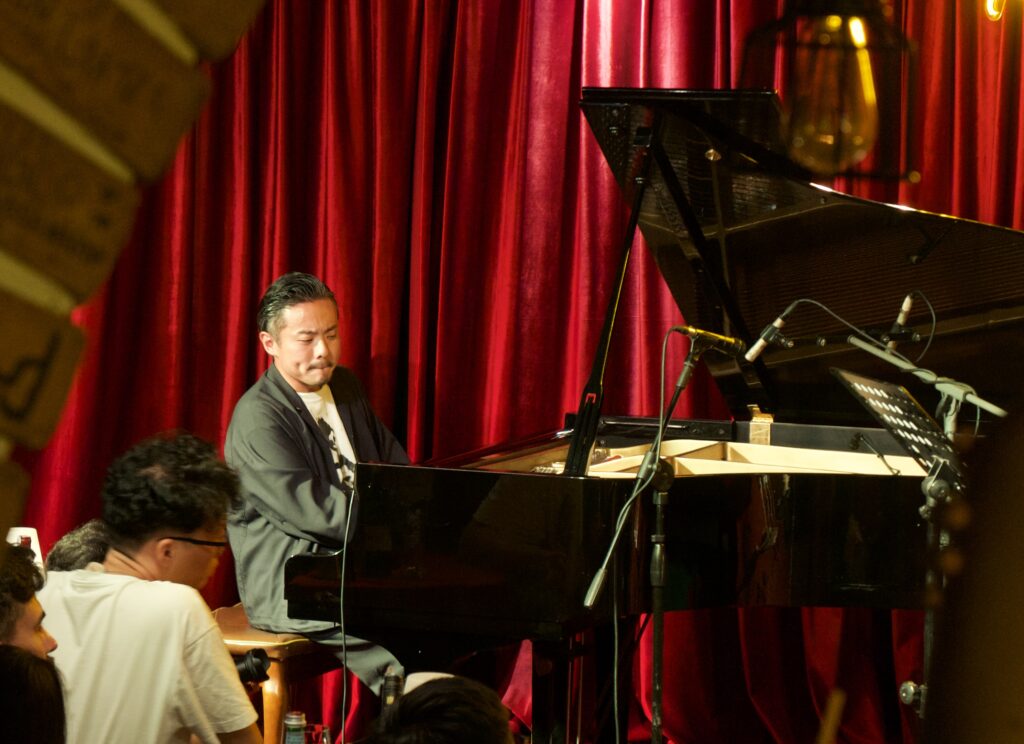
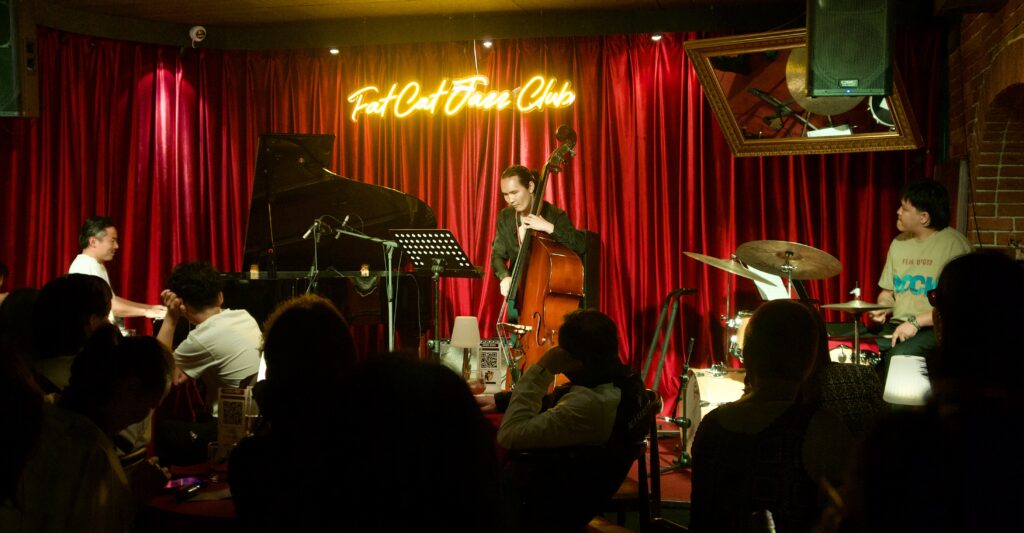
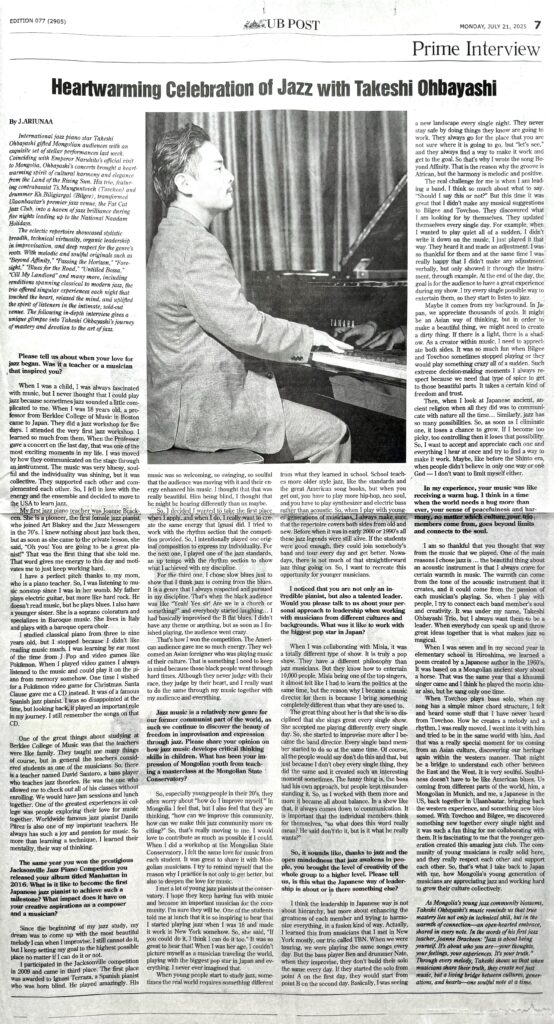
International jazz piano star Takeshi Ohbayashi gifted Mongolian audiences with an exquisite set of stellar performances last week. Coinciding with Emperor Naruhito’s official visit to Mongolia, Ohbayashi’s concerts brought a heartwarming spirit of cultural harmony and elegance from the Land of the Rising Sun. His trio, featuring contrabassist Ts. Munguntovch (Tovchoo) and drummer Kh. Biligjargal (Bilgee), transformed Ulaanbaatar’s premier jazz venue, the Fat Cat Jazz Club, into a haven of jazz brilliance during five nights leading up to the National Naadam Holidays.


The eclectic repertoire showcased stylistic breadth, technical virtuosity, organic leadership in improvisation, and deep respect for the genre’s roots. With melodic and soulful originals such as “Beyond Affinity,” “Passing the Horizon,” “Foresight,” “Blues for the Road,” “Untitled Bossa,” “Cill My Landlord” and many more, including renditions spanning classical to modern jazz, the trio offered singular experiences each night that touched the heart, relaxed the mind, and uplifted the spirit of listeners in the intimate, sold-out venue. The following in-depth interview gives a unique glimpse into Takeshi Ohbayashi’s journey of mastery and devotion to the art of jazz.

A.J. Please tell us about when your love for jazz began. Was it a teacher or a musician that inspired you? What experience made you fall in love with jazz?


T.O. When I was a child, I was always fascinated with music, but I never thought that I could play jazz because sometimes jazz sounded a little complicated to me. When I was 18 years old, a professor from Berklee College of Music in Boston came to Japan. They did a jazz workshop for five days. I attended the very first jazz workshop. I had so much fun learning from them. When Professor gave a concert on the last day, that was one of the most exciting moments in my life. I was moved by how they communicated on the stage through an instrument. The music was very bluesy, soulful and the individuality was shining, but it was collective. They supported each other and complemented each other. So, I fell in love with the energy and the ensemble and decided to move to the USA to learn jazz.


My first jazz piano teacher was Joanne Brackeen. She is a pioneer, the first female jazz pianist who joined Art Blakey and the Jazz Messengers in the 70’s. I knew nothing about jazz back then, but as soon as she came to the private lesson, she said, “Oh you! You are going to be a great pianist!” That was the first thing that she told me. That word gives me energy to this day and motivates me to just keep working hard.


I have a perfect pitch thanks to my mom, who is a piano teacher. So, I was listening to music nonstop since I was in her womb. My father plays electric guitar, but more like hard rock. He doesn’t read music, but he plays blues. I also have a younger sister. She is a soprano coloratura and specializes in Baroque music. She lives in Italy and plays with a baroque opera choir.


I studied classical piano from 3 to 9 years old, but I stopped because I didn’t like reading music much. I was learning by ear most of the time from J Pop and video games like Pokémon. When I played video games I always listened to the music and could play it on the piano from memory somehow. One time I wished for a Pokémon video game for Christmas. Santa Clause gave me a CD instead. It was of a famous Spanish jazz pianist. I was so disappointed at the time, but looking back, it played an important role in my journey. I still remember the songs on that CD.


One of the great things about studying at Berklee College of Music was that the teachers were like family. They taught me many things of course, but in general the teachers considered students as one of the musicians. So, there is a teacher named David Santoro, a bass player who teaches jazz theories. He was the one who allowed me to check out all of his classes without enrolling. We would have jam sessions and lunch together. One of the greatest experiences in college was people exploring their love for music together. World famous jazz pianist Danilo Pérez is also one of my important teachers. He always has such a joy and passion for music. So more than learning a technique, I learned their mentality, their way of thinking.

A.J. The same year you won the prestigious Jacksonville Jazz Piano Competition you released your album titled Manhattan in 2016. What is it like to become the first Japanese jazz pianist to achieve such a milestone? What impact does it have on your creative aspirations as a composer and a musician?


T.O. Since the beginning of my jazz study, my dream was to come up with the most beautiful melody I can when I improvise. I still cannot do it, but I keep setting my goal to the highest possible place no matter if I can do it or not.


I participated in the Jacksonville competition in 2009 and came in third place. The first place was awarded to Ignasi Terraza, a Spanish pianist who was born blind. He played amazingly. His music was so welcoming, so swinging, so soulful that the audience was moving with it and their energy enhanced his music. I thought that that was really beautiful. Him being blind, I thought that he might be hearing differently than us maybe.


So, I decided I wanted to take the first place when I apply, and when I do, I really want to create the same energy that Ignasi did. I tried to work with the rhythm section that the competition provided. So, I intentionally played one original composition to express my individuality. For the next one, I played one of the jazz standards, an up-tempo with the rhythm section to show what I achieved with my discipline.


For the third one, I chose slow blues just to show that I think jazz is coming from the blues. It is a genre that I always respected and pursued in my discipline. That’s when the black audience was like “Yeah! Yes sir! Are we in a church or something?” and everybody started laughing… I had basically improvised the B flat blues. I didn’t have any theme or anything, but as soon as I finished playing, the audience went crazy.


That’s how I won the competition. The American audience gave me so much energy. They welcomed an Asian foreigner who was playing music of their culture. That is something I need to keep in mind because those black people went through hard times. Although they never judge with their race, they judge by their heart, and I really want to do the same through my music together with my audience and everything. 

A.J. Jazz music is a relatively new genre for our former communist part of the world, as such we continue to discover the beauty of freedom in improvisation and expression through jazz. Please share your opinion on how jazz music develops critical thinking skills in children. What has been your impression of Mongolian youth from teaching a masterclass at the Mongolian State Conservatory?


T.O. So, especially young people in their 20’s, they often worry about “how do I improve myself.” In Mongolia I feel that, but I also feel that they are thinking, “how can we improve this community, how can we make this jazz community more exciting?” So, that’s really moving to me. I would love to contribute as much as possible if I could. When I did a workshop at the Mongolian State Conservatory, I felt the same love for music from each student. It was great to share it with Mongolian musicians. I try to remind myself that the reason why I practice is not only to get better, but also to deepen the love for the music.


I met a lot of young jazz pianists at the conservatory. I hope they keep having fun with music and become an important musician for the community. I’m sure they will be. One of the students told me at lunch that it is so inspiring to hear that I started playing jazz when I was 18 and made it work in New York somehow. So, she said, “If you could do it, I think I can do it too.” It was so great to hear that! When I was at her age, I couldn’t picture myself as a musician traveling the world, playing with the biggest pop star in Japan and everything. I never ever imagined that.


When young people start to study jazz, sometimes the real world requires something different from what they learned in school. School teaches more older style jazz, like the standards and the Great American Songbooks, but when you get out, you have to play more hip-hop, neo-soul, and you have to play synthesizer and electric bass rather than acoustic. So, when I play with younger generation of musicians, I always make sure that the repertoire covers both sides from old and new. Before when it was in early 2000 or 1990’s all these jazz legends were still alive. If the students were good enough, they could join somebody’s band and tour every day and get better. Nowadays, there is not much of that straightforward jazz thing going on. So, I want to recreate this opportunity for younger musicians.

A.J. I noticed that you are not only an incredible pianist, but also a talented leader. Would you please talk to us about your personal approach to leadership when working with musicians from different cultures and backgrounds. What was it like to work with the biggest pop star in Japan?


T.O. When I was collaborating with Misia, it was a totally different type of show. It is truly a pop show. They have a different philosophy than jazz musicians. But they know how to entertain 10,000 people. Misia being one of the top singers, it almost felt like I had to learn the politics at the same time, but the reason why I became a music director for them is because I bring something completely different than what they are used to.


The great thing about her is that she is so disciplined that she sings great every single show. She accepted me playing differently every single day. So, she started to improvise more after I became the band director. Every single band member started to do so at the same time. Of course, all the people would say don’t do this and that, but just because I don’t obey every single thing, they did the same and it created such an interesting moment sometimes. The funny thing is, the boss had his own approach, but people kept misunderstanding it. So, as I worked with them more and more it became all about balance. In a show like that, it always comes down to communication. It is important that the individual members think for themselves, “so what does this word really mean? He said don’t do it, but is it what he really wants?”

A.J. So, it sounds like, thanks to jazz and the open mindedness that jazz awakens in people, you brought the level of creativity of the whole group to a higher level. Please tell us, is this what Japanese way of leadership is about or is there something else?


T.O. I think the leadership in Japanese way is not about hierarchy, but more about enhancing the greatness of each member and trying to harmonize everything, in a fusion kind of way. Actually, I learned this from musicians that I met in New York mostly, our trio called TBN. When we were touring, we were playing same songs every day. But the bass player Ben and drummer Nate, when they improvise, they don’t build their solo the same every day. If they started the solo from point A on the first day, they would start from point B on the second day. Basically, I was seeing a new landscape every single night. They never stay safe by doing things they know are going to work. They always go for the place that you are not sure where it is going to go, but “let’s see,” and they always find a way to make it work and get to the goal. So that’s why I wrote the song Beyond Affinity. That is the reason why the groove is African, but the harmony is melodic and positive.


The real challenge for me is when I am leading a band, I think so much about what to say. “Should I say this or not?” But this time it was great that I didn’t make any musical suggestions to Bilgee and Tovchoo. They discovered what I am looking for by themselves. They updated themselves every single day. For example, when I wanted to play quiet all of a sudden, I didn’t write it down on the music, I just played it that way. They heard it and made an adjustment. I was so thankful for them and at the same time I was really happy that I didn’t make any adjustment verbally, but only showed it through the instrument, through example. At the end of the day, the goal is for the audience to have a great experience during my show. I try every single possible way to entertain them, so they start to listen to jazz.


Maybe it comes from my background. In Japan, we appreciate thousands of gods. It might be an Asian way of thinking, but in order to make a beautiful thing, we might need to create a dirty thing. If there is a light, there is a shadow. As a creator within music, I need to appreciate both sides. It was so much fun when Bilgee and Tovchoo sometimes stopped playing or they would play something crazy all of a sudden. Such extreme decision-making moments I always respect because we need that type of spice to get to those beautiful parts. It takes certain kind of freedom and trust.


Then, when I look at Japanese ancient, ancient religion when all they did was to communicate with nature all the time… Similarly, jazz has so many possibilities. So, as soon as I eliminate one, it loses a chance to grow. If I become too picky, too controlling then it loses that possibility. So, I want to accept and appreciate each one and everything I hear at once and try to find a way to make it work. Maybe, like before the Shinto era, when people didn’t believe in only one way or one God — I don’t want to limit myself either.

A.J. In my experience, your music was like receiving a warm hug. I think in a time when the world needs a hug more than ever, your sense of peacefulness and harmony, no matter which culture your trio members come from, goes beyond limits and connects to the soul. What impression will you be leaving Mongolia with?


T.O. I am so thankful that you thought that way from the music that we played. One of the main reasons I chose jazz is … the beautiful thing about an acoustic instrument is that I always crave for certain warmth in music. The warmth can come from the tone of the acoustic instrument that it creates, and it could come from the passion of each musician’s playing. So, when I play with people, I try to connect each band member’s soul and creativity. It was under my name, Takeshi Ohbayashi Trio, but I always want them to be a leader. When everybody can speak up and throw great ideas together that is what makes jazz so magical.


When I was 7 and in my second year in elementary school in Hiroshima, we learned a poem created by a Japanese author in the 1960’s. It was based on a Mongolian ancient story about a horse. That was the same year that a khuumii singer came and I think he played the morin khuur also, but he sang only one time.


When Tovchoo plays bass solo, when my song has a simple minor chord structure, I felt and heard some stuff that I have never heard from Tovchoo. How he creates a melody and a rhythm, I was really moved. I went into it with him and tried to be in the same world with him. And that was a really special moment for us coming from an Asian culture, discovering our heritage again within the western manner. That might be a bridge to understand each other between the East and the West. It is very soulful. Soulfulness doesn’t have to be like American blues. Us coming from different parts of the world, him, a Mongolian in Munich, and me, a Japanese in the US, back together in Ulaanbaatar, bringing back the western experience, and something new blossomed. With Tovchoo and Bilgee, we discovered something new together every single night and it was such a fun thing for me collaborating with them. 


It is fascinating to me that the younger generation people created this amazing jazz club. The community of young musicians is really solid here, and they really respect each other and support each other. So, that’s what I take back to Japan with me, how Mongolia’s young generation of musicians are appreciating jazz and working hard to grow their culture collectively.

As Mongolia’s young jazz community blossoms, Takeshi Ohbayashi’s music reminds us that true mastery lies not only in technical skill, but in the warmth of connection — an open-hearted embrace, shared in every note. In the words of his first jazz teacher, Joanne Brackeen: “Jazz is about being yourself. It’s about who you are — your thoughts, your feelings, your experiences. It’s your truth.” Through every melody, Takeshi shows us that when musicians share their truth, they create not just music, but a living bridge between cultures, generations, and hearts — one soulful note at a time.

J. Ariunaa
Published in UB Post
July 21, 2025

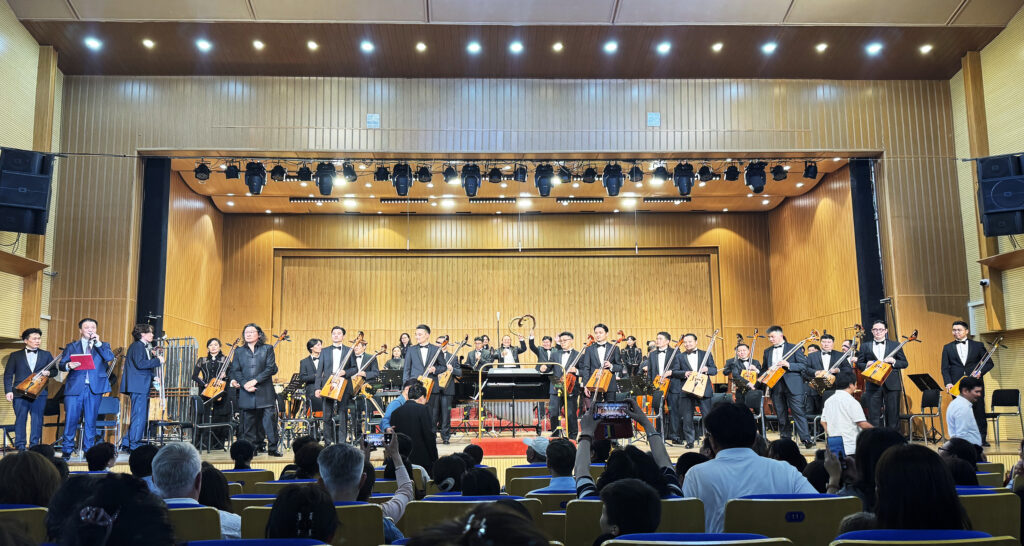
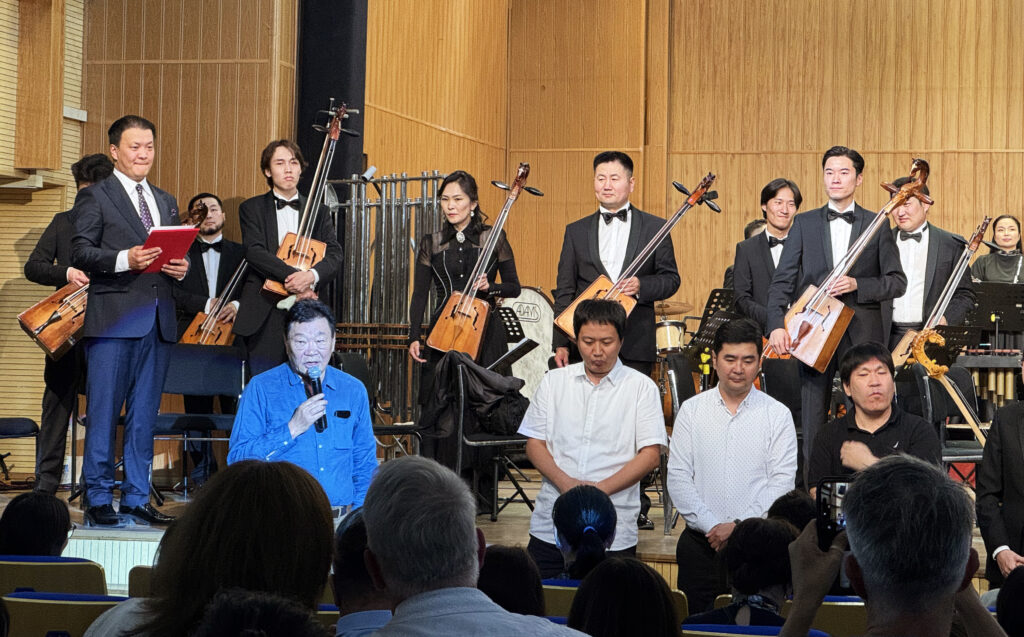
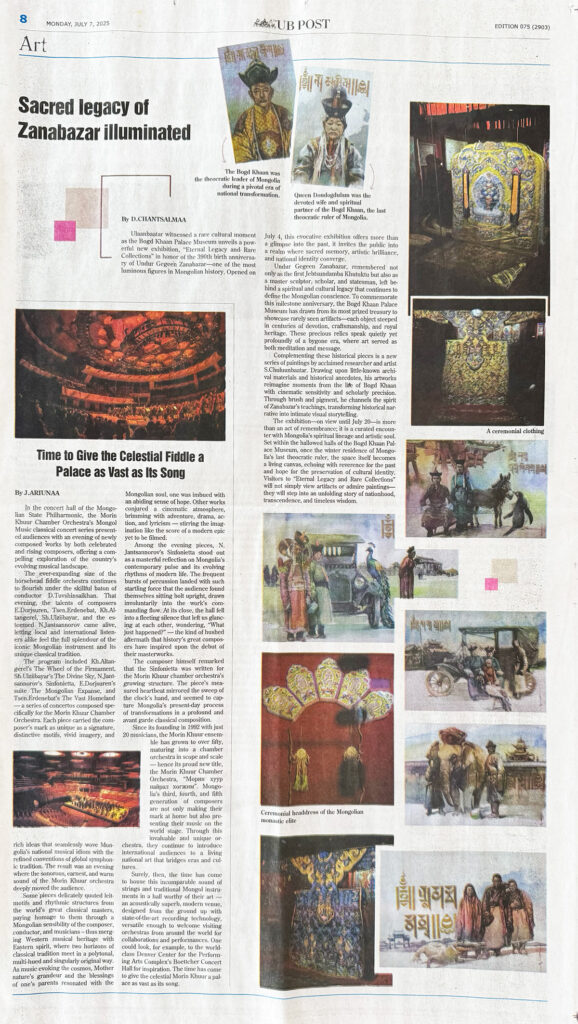
In the concert hall of the Mongolian State Philharmonic, the Morin Khuur Chamber Orchestra’s Mongol Music classical concert series presented audiences with an evening of newly composed works by both celebrated and rising composers, offering a compelling exploration of the country’s evolving musical landscape.


The ever-expanding size of the horsehead fiddle orchestra continues to flourish under the skillful baton of conductor D. Tuvshinsaikhan. That evening, the talents of composers E. Dorjsuren, Tsen. Erdenebat, Kh. Altangerel, Sh. Ulziibayar, and the esteemed N. Jantsannorov came alive, letting local and international listeners alike feel the full splendour of the iconic Mongolian instrument and its unique classical tradition.


The program included Kh. Altangerel’s The Wheel of the Firmament, Sh. Ulziibayar’s The Divine Sky, N. Jantsannorov’s Sinfonietta, E. Dorjsuren’s suite The Mongolian Expanse, and Tsen. Erdenebat’s The Vast Homeland — a series of concertos composed specifically for the Morin Khuur Chamber Orchestra. Each piece carried the composer’s mark as unique as a signature, distinctive motifs, vivid imagery, and rich ideas that seamlessly wove Mongolia’s national musical idiom with the refined conventions of global symphonic tradition. The result was an evening where the sonorous, earnest, and warm sound of the Morin Khuur orchestra deeply moved the audience.

Some pieces delicately quoted leitmotifs and rhythmic structures from the world’s great classical masters, paying homage to them through a Mongolian sensibility of the composer, conductor, and musicians – thus merging Western musical heritage with Eastern spirit, where two horizons of classical tradition met in a polytonal, multi-hued and singularly original way. As music evoking the cosmos, Mother nature’s grandeur and the blessings of one’s parents resonated with the Mongolian soul, one was imbued with an abiding sense of hope. Other works conjured a cinematic atmosphere, brimming with adventure, drama, action, and lyricism — stirring the imagination like the score of a modern epic yet to be filmed.


Among the evening’s pieces, N. Jantsannorov’s Sinfonietta stood out as a masterful reflection on Mongolia’s contemporary pulse and its evolving rhythms of modern life. The frequent bursts of percussion landed with such startling force that the audience found themselves sitting bolt upright, drawn involuntarily into the work’s commanding flow. At its close, the hall fell into a fleeting silence that left us glancing at each other, wondering, “What just happened?” — the kind of hushed aftermath that history’s great composers have inspired upon the debut of their masterworks.


The composer himself remarked that the Sinfonietta was written for the Morin Khuur chamber orchestra’s growing company. The piece’s measured heartbeat mirrored the sweep of the clock’s hand, and seemed to capture Mongolia’s present-day process of transformations in the profound and avant-garde classical composition.

Since its founding in 1992 with twenty musicians, the Morin Khuur ensemble has grown to over fifty, maturing into a chamber orchestra in scope and scale — hence its proud new title, the Morin Khuur Chamber Orchestra, “Морин хуур найрал хөгжим.” Mongolia’s third, fourth, and fifth generation of composers are not only making their mark at home but also presenting their music on the world stage. Through this invaluable and unique orchestra, they continue to introduce international audiences to a living national art that bridges eras and cultures.


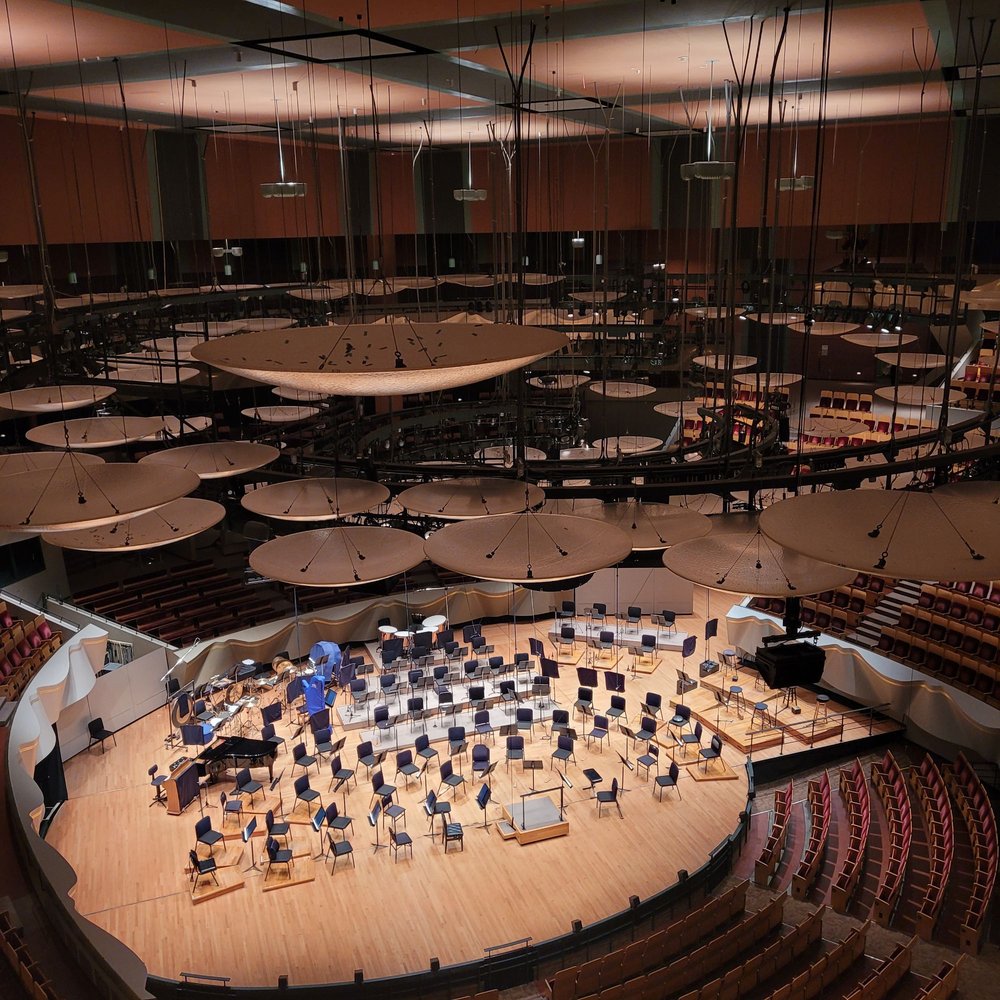
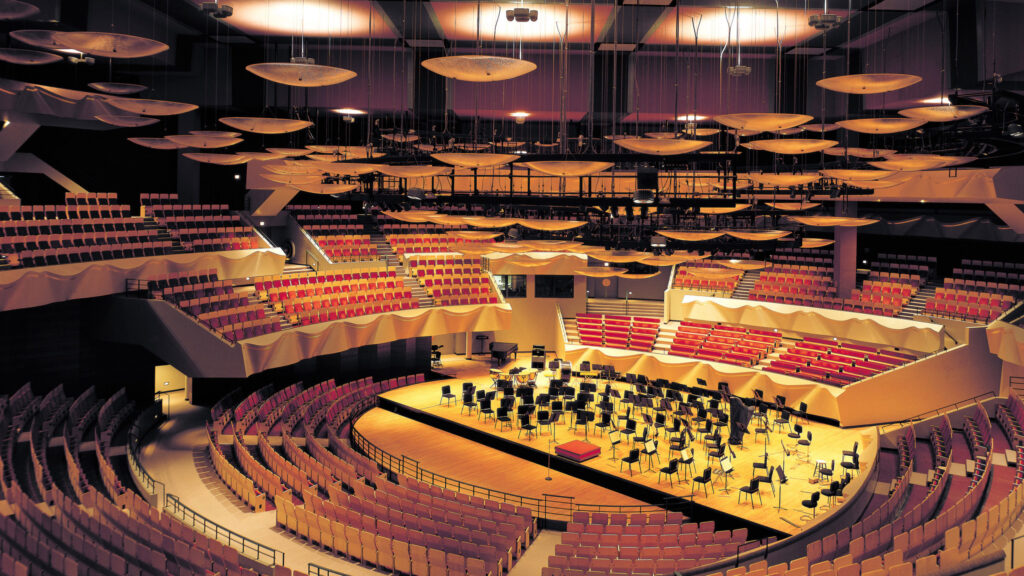
Surely, then, the time has come to house this incomparable stringed vessel of song and other traditional Mongol instruments in a hall worthy of their art — an acoustically superb, modern venue, designed from the ground up with state-of-the-art recording technology, versatile enough to welcome visiting orchestras from around the world for collaborations and performances. One could look, for example, to the world-class Boettcher Concert Hall of the Denver Center for the Performing Arts Complex in the USA for inspiration.


The time has come to give the celestial Morin Khuur a palace as vast as its song.

J. Ariunaa
Published in UB Post
July 7, 2025

In this episode, we travel to Poland and explore its culture, history, geography, economic development, key sectors, Mongolian and Polish relations, and highlight the Presidential visit in March 2025.
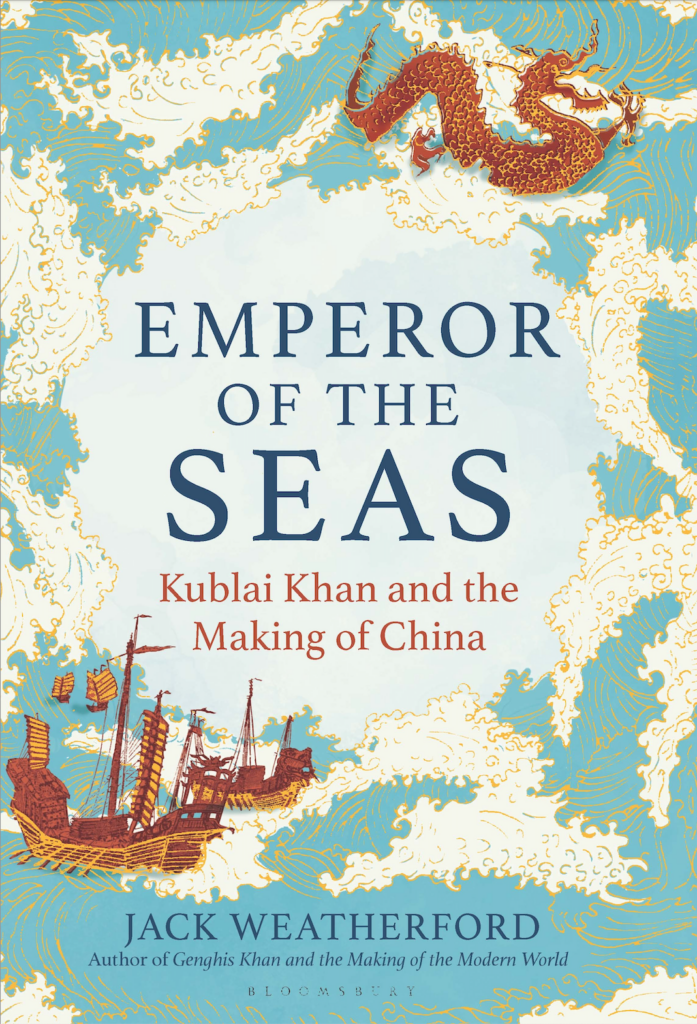
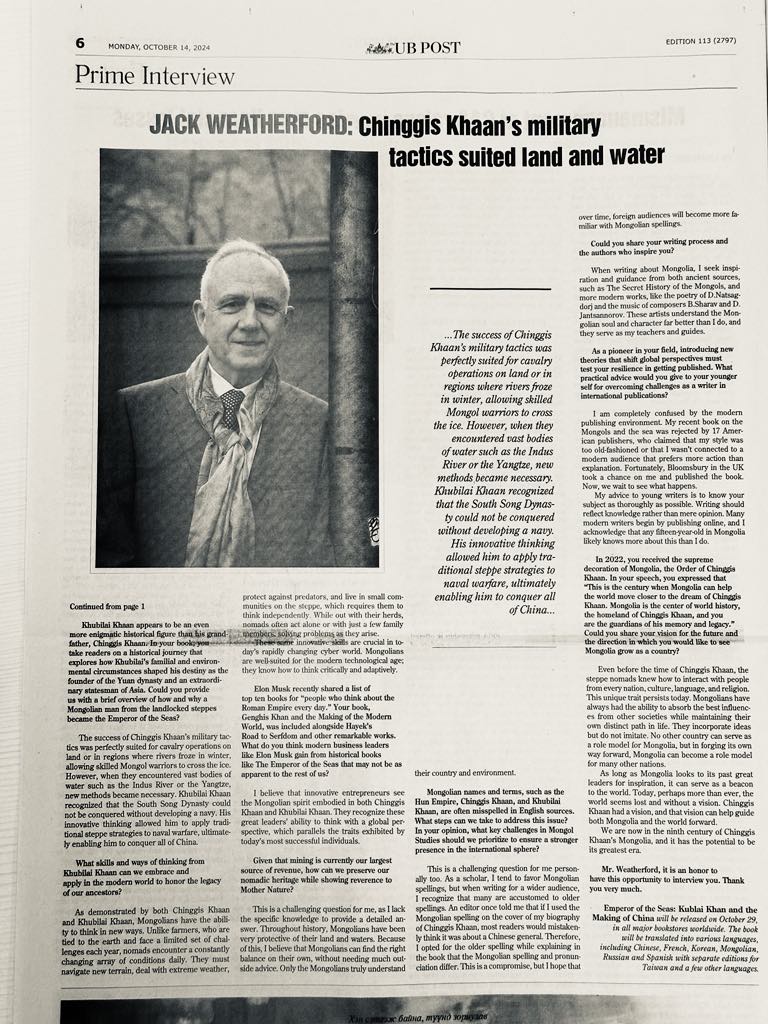
Jack Weatherford is a renowned cultural anthropologist, bestselling author and scholar on Chinggis Khaan. His books, Genghis Khan and the Making of the Modern World, The Secret History of the Mongol Queens and Genghis Khan and the Quest for God, have broken new ground in the global understanding of the impact of the Mongols on medieval history and the modern world. Mr. Weatherford’s writing, informed by his fieldwork expertise, enriches the historical non-fiction genre with a captivating style that takes readers on a journey to explore the lives of people whose histories were previously concealed in long-forgotten, cryptic sources. In 2022 he received the Order of Chinggis Khaan, the supreme decoration of the Mongolian State. His latest book, The Emperor of the Seas – Kublai Khan and the Making of China will be released on October 29, 2024. 

AJ. Khubilai Khaan appears to be an even more enigmatic historical figure than his grandfather, Chinggis Khaan. In your book, you take readers on a historical journey that explores how Khubilai’s familial and environmental circumstances shaped his destiny as the founder of the Yuan dynasty and an extraordinary statesman of Asia. Could you provide us with a brief overview of how and why a Mongolian man from the landlocked steppes became the Emperor of the Seas?


JW. The success of Chinggis Khaan’s military tactics was perfectly suited for cavalry operations on land or in regions where rivers froze in winter, allowing skilled Mongol warriors to cross the ice. However, when they encountered vast bodies of water such as the Indus River or the Yangtze, new methods became necessary. Khubilai Khaan recognized that the South Song Dynasty could not be conquered without developing a navy. His innovative thinking allowed him to apply traditional steppe strategies to naval warfare, ultimately enabling him to conquer all of China.


AJ. What skills and ways of thinking from Khubilai Khaan can we embrace and apply in the modern world to honor the legacy of our ancestors?


JW. As demonstrated by both Chinggis Khaan and Khubilai Khaan, Mongolians have the ability to think in new ways. Unlike farmers, who are tied to the earth and face a limited set of challenges each year, nomads encounter a constantly changing array of conditions daily. They must navigate new terrain, deal with extreme weather, protect against predators, and live in small communities on the steppe, which requires them to think independently. While out with their herds, nomads often act alone or with just a few family members, solving problems as they arise.


These same innovative skills are crucial in today’s rapidly changing cyber world. Mongolians are well-suited for the modern technological age; they know how to think critically and adaptively.


AJ. Elon Musk recently shared a list of top ten books for “people who think about the Roman Empire every day.” Your book, Genghis Khan and the Making of the Modern World, was included alongside Hayek’s Road to Serfdom and other remarkable works. What do you think modern business leaders like Elon Musk gain from historical books like The Emperor of the Seas that may not be as apparent to the rest of us? 


JW. I believe that innovative entrepreneurs see the Mongolian spirit embodied in both Chinggis Khaan and Khubilai Khaan. They recognize these great leaders’ ability to think with a global perspective, which parallels the traits exhibited by today’s most successful individuals.


AJ. Given that mining is currently our largest source of revenue, how can we preserve our nomadic heritage while showing reverence to Mother Nature? Could you share your thoughts on how to approach the challenges of urbanization alongside the preservation of nomadic traditions?


JW. This is a challenging question for me, as I lack the specific knowledge to provide a detailed answer. Throughout history, Mongolians have been very protective of their land and waters. Because of this, I believe that Mongolians can find the right balance on their own, without needing much outside advice. Only the Mongolians truly understand their country and environment.

AJ. Mongolian names and terms, such as the Hunnu Empire, Chinggis Khaan, and Khubilai Khaan, are often misspelled in English sources. What steps can we take to address this issue? In your opinion, what key challenges in Mongol Studies should we prioritize to ensure a stronger presence in the international sphere?


JW. This is a challenging question for me personally. As a scholar, I tend to favor Mongolian spellings, but when writing for a wider audience, I recognize that many are accustomed to older spellings. An editor once told me that if I used the Mongolian spelling on the cover of my biography of Chinggis Khan, most readers would mistakenly think it was about a Chinese general. Therefore, I opted for the older spelling while explaining in the book that the Mongolian spelling and pronunciation differ. This is a compromise, but I hope that over time, foreign audiences will become more familiar with Mongolian spellings.


AJ. Could you share your writing process and the authors who inspire you? 


JW. When writing about Mongolia, I seek inspiration and guidance from both ancient sources, such as The Secret History of the Mongols, and more modern works, like the poetry of D. Natsagdorj and the music of composers B. Sharav and D. Jantsannorov. These artists understand the Mongolian soul and character far better than I do, and they serve as my teachers and guides.


AJ. As a pioneer in your field, introducing new theories that shift global perspectives must test your resilience in getting published. What practical advice would you give to your younger self for overcoming challenges as a writer in international publications?


JW. I am completely confused by the modern publishing environment. My recent book on the Mongols and the sea was rejected by 17 American publishers, who claimed that my style was too old-fashioned or that I wasn’t connected to a modern audience that prefers more action than explanation. Fortunately, Bloomsbury in the UK took a chance on me and published the book. Now, we wait to see what happens.


My advice to young writers is to know your subject as thoroughly as possible. Writing should reflect knowledge rather than mere opinion. Many modern writers begin by publishing online, and I acknowledge that any fifteen-year-old in Mongolia likely knows more about this than I do.


AJ. In 2022, you received the supreme decoration of the Mongolian State, the Order of Chinggis Khaan. In your speech, you expressed that “This is the century when Mongolia can help the world move closer to the dream of Chinggis Khaan. Mongolia is the center of world history, the homeland of Chinggis Khaan, and you are the guardians of his memory and legacy.” Could you share your vision for the future and the direction in which you would like to see Mongolia grow as a country? 


JW. Even before the time of Chinggis Khaan, the steppe nomads knew how to interact with people from every nation, culture, language, and religion. This unique trait persists today. Mongolians have always had the ability to absorb the best influences from other societies while maintaining their own distinct path in life. They incorporate ideas but do not imitate. No other country can serve as a role model for Mongolia, but in forging its own way forward, Mongolia can become a role model for many other nations.


As long as Mongolia looks to its past great leaders for inspiration, it can serve as a beacon to the world. Today, perhaps more than ever, the world seems lost and without a vision. Chinggis Khaan had a vision, and that vision can help guide both Mongolia and the world forward. 


We are now in the ninth century of Chinggis Khaan’s Mongolia, and it has the potential to be its greatest era.


Mr. Weatherford, it is an honor to have this opportunity to interview you. Thank you very much.


Emperor of the Seas: Kublai Khan and the Making of China will be released in all major bookstores worldwide and translated into French, Russian, Spanish, Korean, Mongolian, and Chinese, with separate editions for Taiwan and a few other languages.

J. Ariunaa

Published in UB Post

October 14, 2024

The first episode of the Dafacto World series kicks off at Yokohama to south of Tokyo. The port at this city was where Japan’s journey to the new world began.

The Meiji era began in 1868 with Emperor Meiji being the 122nd Empreror of Japan. This year marked the opening of Japan’s doors to the outside world. Japan implemented modernization and Westernization to its soil during this 45-year period.

The emperor renamed the capital city Edo, which was the political and economic center of the country, to Tokyo in 1868. However, the bay of the city in the east and south side kept its name Edo.

Fukuzawa Yukichi, a man of englightenment who is portrayed on the ten thousand yen bill, said in his 1853 memoirs of Yokohama shores to the west of Edo bay that “one morning, the Japanese people were alarmed by the presence of massive dark ships in Yokohama, with some interpreting the event as the arrival of Black Devil”.

This was the arrival of 9 large ships commanded by the US captain M.Perry. The event caused a shockwave through Japan. The Japanese realized the sheer difference of power between the warships of other countries and Japan’s wooden ships, leading to the belief that they need to learn how to make those and get to know the West better.

The three centuries of Japanese isolation in Edo period was the underlying cause of this weakness. They immediately began relations with the US which masters making these massive ships. First, they sent their intellectuals and businesspeople to study. The unrestricted entry of foreign ships to the Yokohama port enabled the flow of foreign culture and information, introducing the Japanese to Western food and drinks, culture, and arts. Yokohama is often named as the birthplace of the modern Japanese culture.

Besides being a cultural hub, this city also laid the foundation of modern industries in Japan. The mass production of automobiles began in this city. Nissan built is manufacturing plant here in 1935 and set the record of producing 15 thousand cars within two years. The the first prototype was called Datsun Model-14. Now, a car called GTR is being developed, which can accelerate up to 340km.  

Yokohama city is the capital of Kanagawa prefecture – one of the 9 regions and 42 prefectures in Japan. The city is developing rapidly.

Today, Yokohama is a major hub for industry and business in Japan, housing the headquarters of most Japanese corporations and boasting the country’s history of industrialization.

Thus, this harbor in Yokohama saw the fist steps of the great reforms leading to the rise ofJapan as the industrial powerhouse we know today.

In recent years, contemporary art in Mongolia has become a highly marketable publicity device. Insert contemporary art into any event, show, concert, party, or ceremony anywhere in Mongolia and voila! Anyone who wants to be considered fashionable is even ready to borrow money to be able to join and take selfies at the trendy scene.

That contemporary art and artists are becoming a hit on the news and social media is a desirable step toward progress. In a country with a small population, where art is generally synonymous with entertainment, raising awareness of contemporary art should ideally contribute to positive changes in initiating long-term solutions to important issues in our society. In reality, however, this is not entirely the case, as contemporary art is more often applied as a marketing tool for the organizers of shows. This results in us, the viewers, giving a lot of attention to its form and not enough attention to its content.

In June of this year, the Arts Council of Mongolia organized the International Media Art Festival. It took place in several locations in Ulaanbaatar and Sainshand, the capital of Dornogobi province. Blue Sun Contemporary Art Center artists (Yo. Dalkh-Ochir, S. Khulan, N. Soninbayar, D. Erdenejargal, J. Shijirbaatar, B. Tuguldur, D. Tsenguun, E. Enkhzaya, J. Anunaran, D. Otgonbayar, B. Bat-Erdene) partook in the Dornogobi segment of the festival by showcasing their unique artworks as part of the Blue Sun signature project – Art Camp.

In order to bring contemporary art closer to its main purpose, for more successful future events, it would be beneficial to concentrate in this article on the things that could be improved, rather than praise the feats accomplished by the organizers and artists during the Dornogobi trip.

The core idea behind Art Camp is for artists to come up with concepts and create artworks based on their relationship with the location and its community. Therefore, works displayed in Art Camp tend to be more often like seeds of original ideas that will be developed into fully finished works of art later on. And although desirable, it is not obligatory for artists to present their concepts as complete works of art on the spot. In other words, Art Camp’s unique advantage is that it provides a natural setting for the works of art to be seen during the experimental phase of the creative process. Thus, the experience itself becomes a part of the art, consequently adding value to the creations with respect to the time and thought invested in the final work.

The Art Camp that took place in Dornogobi, for the most part, left out this key point of the project. The majority of the artworks displayed there seemed to be transported from the place they were created beforehand and simply presented at the location. And although the resulting exhibition in the city park of Sainshand and under the open sky of Dornogobi was appealing, one was left with a sense that most of the artists were rushed to either complete the presentation or get through it without fully or liberally contemplating the concepts. Nevertheless, given the sandstorms and 40-degree-Celsius heat, the Blue Sun artists tried to make the best of the trip.

Still, considering that the rest of the artworks presented at the International Media Art Festival were created, as the name suggests, with audiovisual media and programming technology in mind, the Blue Sun Art Camp segment in this event, having been divested of its conceptual context and primary purpose, overall looked rather like a superfluous appendage to the festival.

Yet, Art Camp plays a crucial role in Mongolian contemporary art. It was in 1992 that the projects initiated by Yo. Dalkh-Ochir and fellow artists focusing on conceptual, performance, and land art became known as “Art Camp” and “Land Art” today. Following Mongolia’s transition from communism to democracy, creators of movements such as these became pioneers of a new genre in the country as they first began to travel freely and showcase their art internationally. Art Camp is a valuable project that saw Mongolia’s vast natural landscapes as a symbolic setting for the intellectual freedom in creativity expressed through many Mongolian conceptual art movements. Today, as a continuation of this legacy, Blue Sun Contemporary Art Center is a significant link between the generation of artists who helped develop contemporary art in Mongolia and the new generation of young artists who are enriching it with their unique creativity and talent.

At present, however, some challenges seem to hinder Mongolian contemporary art from having a greater impact on the development of our society. These challenges pertain not as much to the art itself as to the attitudes and functions assumed by the groups and parties involved in organizing its presentation.

Councils, unions, societies, associations, and governments exist in a democracy because individual members approve of their function. The purpose of such institutions, as it relates to art, is to provide support by organizing the creative fruits of artists’ labor. The institutions do not create art. Individual artists do. In reality, however, the roles seem to be reversed and the responsibilities and privileges confused in Mongolia. Projects that need support are set aside, while the ones that achieve success through the sheer effort and hard work of the artists are being exploited as publicity tools by institutions. Our art officials, with their consumerist groupthink, like rhinoceroses in a porcelain shop, more often than not impede the delicate process of special creations with their improvident plans and impetuous financing interventions. Under the guise of support, artists often get bullied into delivering half-baked outcomes so that the public perceives the loudest self-promoting officials as heroes.

The question remains, should contemporary art be approached simply as a gimmick in haphazard cultural shows, or could we prioritize artists and the organic fruition of their creative processes by providing tangible support with a long-term vision? Could we give as much consideration to the content as we do to the form, and in the process, make a bit more of an effort in giving credit where credit is actually due? Could we support not the officials who are upstaging the artists after their work is done, but the real creators of art who are addressing important issues in our society?

These questions arise more and more at the large cultural events, shows, and exhibitions that are being organized recently. The time has come for the art institutions involved in organizing these events to approach their role in art responsibly: not simply to appear important and democratic on the surface while governing with a totalitarian attitude, but to actually be democratic throughout the entire process, and to treat the makers of creative value with the same respect and consideration that the art officials give to themselves.

Given that organizing large events with many segments and artists is not an easy task, especially considering the aftermath of the pandemic, M. Batzorig, the chief curator of the International Media Art Festival, together with the Arts Council staff did their best with what they had. Whether it involved technological media or conceptual sculptures or performance art, the works that were exhibited provided valuable ideas and insights. Consciousness and awareness were common themes among the artworks exhibited at the Art Camp of Dornogobi. So, there is still hope that the questions raised above by contemporary art will bring much-needed improvement to our culture.

By Ariunaa Jargalsaikhan
Published in UBPost on July 27, 2022
Ulaanbaatar

a86eec13b9f80cf83fed4d42f1050bce.jpeg

The two bounds of Central Asia came together as traditional Turkish and Mongolian music wove a wreath of folk songs across time and distance last week at the Ulaanbaatar Theater. The crescent moon and its vibrant star reflected in the enchanting tunes of the saz – a long-necked lute – and the zurna – a woodwind instrument – against the background of the eternal blue sky.

Four folk music masters – Salih Gündoğdu, Eren Can Yıldız, Mücahid Kol, and Buğra Kutbay – from the Turkish capital, Ankara, in collaboration with the Ulaanbaatar Theater music ensemble, immersed the audience in an enthralling concert. The program consisted of lyrical and rhythmic Turkish traditional melodies played in the first half and lively Mongolian traditional music and dance performed in the second half. The evening ended on a spirited note with an arrangement of R. Bat-Erdene’s Mongolian contemporary classical piece, “The Gallop of Approaching Steeds,” by Ulaanbaatar Theater composer O. Chinbat for the Turkish quartet as the lead.

Palpable in the music was the nomadic spirit that upholds adaptability to change and reverence for freedom and nature as the traditional guiding principles in these cultures that emerged from nomadic roots. They are reflected in shared values such as efficacy in action and religious tolerance. Both Turkish and Mongolian folk melodies speak to the essential presence of nature in the impermanence of life.

The Sky Turks inhabited the land of the eternal blue sky between the 6th and 8th centuries AD and carved the first written use of the name Turk in ancient Turkic runes onto the Tonyukuk stone from the 8th century, located in the Tuul river valley.1 They worshiped Tengri, who symbolized the universe and its laws. This was the same Tenger deified five centuries later by Chinggis Khaan, the founder of the Mongol State. As two of the numerous steppe tribes to have originated in Mongolia, the Turkic and Mongol nomadic empires had a great influence on one another throughout various periods in history.

The Turkish musical scale called Makam Ussak is remarkably unique.2 It has more tonal variations in between notes than classical Western and Eastern harmonies. These microtones tend to make Turkish music sound sharper and higher in resonance by comparison to well-known Middle Eastern harmonies. Thus, the versatility of the tonal variations in Turkish traditional music carries a special expression of the richness in natural landscapes and cultural diversity that Turkey is blessed with thanks to its unique geographical location.

It is interesting to note that in the 13th century, the Mongol armies employed the beats of shamanic drums to prepare for battle.3 War drums were part of the Mongol military tactic to frighten the enemy from a distance before the start of a conquest.4 From the 14th century onward, the elite military forces of the Ottoman Empire refined the tactic into an entire art form. The Janissaries and their battle marches became so legendary that in the 18th century, their beats and rhythm inspired W. A. Mozart to write one of the evergreen favorites of classical music, the third movement of Sonata No. 11, better known as “The Turkish March.”

As Turkish and Mongolian musicians united in retelling the tales of brotherhood through music that evening, the crescent moon and its star shone brightly in the eternal blue sky. It was as though their songs soothed the souls and uplifted the spirits of listeners and wove a wreath of marvelous beauty across time and distance over the steppes of our ancestors.

References: 

1. Weatherford, Jack. Genghis Khan and the Quest for God. New York: Penguin Books, 2016. (Chp. 3)

2. “The Difference Between Quartertones in Persian, Arabic, and Turkish Music.” YouTube, uploaded by OudforGuitarists, 16 May 2015, https://youtu.be/YCVFkircZUg. Accessed 10 April 2022.

3. Kappler, Claude-Claire et René. Guillaume de Rubrouck, Envoyé de Saint Louis: Voyage dans l’Empire mongol (1253-1255). Paris: Payot, 1985. (Chp. 35, Note 11)

4. Rustichello of Pisa. The Travels of Marco Polo, Vol. 1. Scotland: Yule-Cordier, 1902. (Book 2, Chp. 4, Note 3)

5. “The Differences and Similarities between Turkish and Western Music.” YouTube, uploaded by Atesh Electric, 16 October 2020, https://youtu.be/s4h0NdnOGQY. Accessed 10 April 2022.

6. Kultur Yasam. “11 Instruments Used in Turkish Music.” https://kulturveyasam.com/turk-muziginde-kullanilan-11-calgi/?fbclid=IwAR2hluVxYLKqyAY5K0cFOiFrpqaFsS48TOpi3lxFaFpjYvDwInDvNcCw4l8. Accessed 10 April 2022.

By Ariunaa Jargalsaikhan
Published in UB Post on April 15, 2022
Ulaanbaatar

French language, as a vehicle of culture and diplomacy, possesses a special combination of melodiousness and logic that structures thought and challenges critical thinking. The musicality of the French language has an elegant capacity to deliver powerful messages with lightness and grace. It is estimated that roughly over 400 million people speak French across North and South Americas, Europe, Africa, Southeast Asia, and beyond. No wonder, UNESCO gives prominence to French as its working language and promotes it by supporting Francophone cultures in different ways. The French language is like a key that opens doors to many countries.

On the occasion of the International Day of Francophonie on March 20, the French Alliance of Mongolia in collaboration with the Embassy of France and francophone partners widely organized a series of French language and culture events at various favorite cultural sights of Ulaanbaatar. For over two weeks, French language speakers and enthusiasts in Mongolia united in celebrating the richness in diversity of francophone cultures through music, theater, cuisine, literature, visual art, film, and more.

This year marked the 23rd time that the Festival of Francophone cultures was held in Mongolia. L’Alliance Française placed a great emphasis on youth and French language students, who actively participated in competitions of poetry, recitation, song, dictation, and composition. The first-place winners were awarded a week-long trip to Paris. The French language competitions contributed to the development of interest in French-language education for participants and helped viewers to expand their knowledge in different realms of culture, language, and art.

As Mongolian students stepped up to the challenge to showcase their talent and creativity on stage, the audience also cheered for the brave ones who persevered through mistakes until the very end. Overall, however, one could sense the necessity for the Mongolian education system to encourage more intellectual expression and creativity in schools instead of solely fixating on academic performance. In French culture, children are brought up from an early age to formulate their opinion, engage in debates over what is happening around them, and express freely how they feel. Such practices could serve well in developing the competitiveness of Mongolian youth in the future.

On the closing day, a festival gathered audiences for French music and opera at Sukhbaatar Square. Following the aftermath of the global pandemic, however, visitors were fewer than normally expected. Still, the cultural fair attracted a good number of individuals and united many like-minded people. Francophone organizations, institutions, restaurateurs, and businesses active in sectors of ecotourism, energy, agriculture, education and research, and science and technology partook in the fair. The windchill of a Mongolian spring day did not discourage participants from enjoying themselves under the sunny sky.

Relations between France and Mongolia go back to the 13th century, when French artisans, sculptors, and missionaries braved the cold and experienced the customs of people living across the Mongol Empire and made valuable contributions to the Mongolian cultural heritage and history. In modern times, France was one of the first developed countries to acknowledge Mongolia as an independent nation when the latter joined the United Nations in 1961. Currently, France continues to set an example as one of the leaders in strengthening the rule of law and combatting climate change in the world – both are vital issues for the development of Mongolia.

Francophone culture days are an important part of intercultural dialogue. They develop mutual understanding and create more harmonious relations among different cultures. The expression and awareness of the abundance of cultural diversity in society are significant markers of democracy and human rights. From Francophone days, we could reflect on new ways of celebrating cultural pluralism in Mongolia. Increased understanding and knowledge of diverse cultures raise the quality of life for a nation’s citizens. The enrichment of spirits and relationships for viewers, participants, and organizers also helps unite a nation.

In an era of globalization, intercultural dialogue plays a consequential role in protecting and treasuring cultural diversity. As information and technology bring human beings ever closer in contact with one another, the richness of identities shaped by a multitude of traditions and geographies thrives on open-minded communication. Intercultural dialogues serve as a proponent of peace. Lasting a few days, the cultural events might seem momentary when completed, but the impact on members of society can have lasting positive effects. They reduce negative stereotypes and prejudices that engender fear and conflict. Cultural days build trust and bring out kindness in people.

By Ariunaa Jargalsaikhan
Published in UB Post on March 30, 2022
Ulaanbaatar