




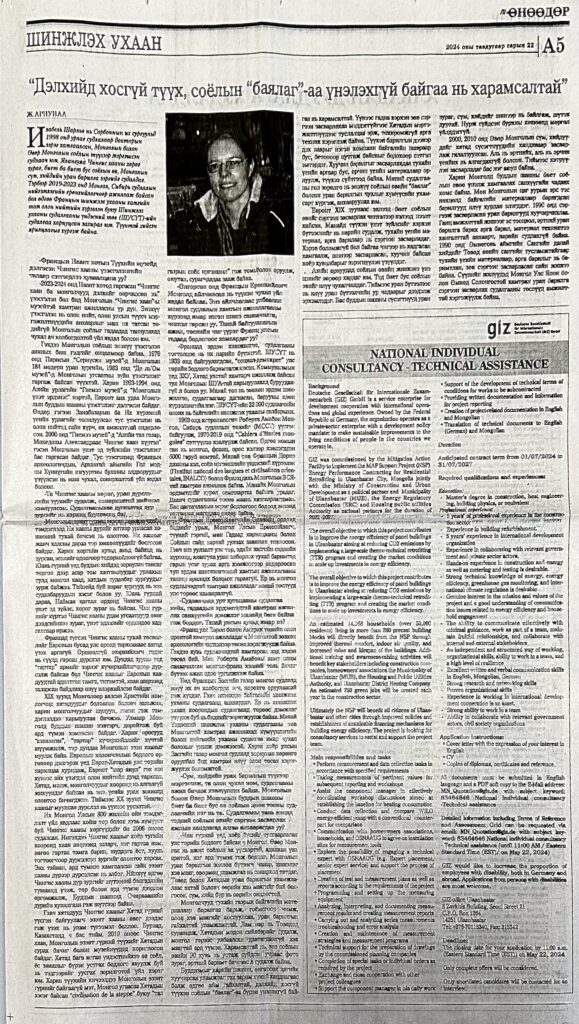
2024 оны 5-р сарын 15
Парис – Улаанбаатар
Ярилцлага

Isabelle Charleux (Изабель Шарльө)
Судалгааны Захирал
Францын Үндэсний Шинжлэх ухааны Судалгааны Төв – Centre National de la Recherche Scientifique (CNRS)
Ж.А. : Хатагтай Изабель Шарльө, ярилцлагын урилгыг маань хүлээн авч Франц дахь Монгол судлалын мэргэжлтний санал бодлоо хуваалцах болсонд танд талархаж байна. Та Сорбонны Их сургуульд 1998 онд урлаг судлалаар доткторын зэрэг хамгаалсан, Монгол улсын ба Өвөр Монголын соёлын түүхээр мэрэгшсэн судлаач. Ялангуяа Чингис Хааны хөрөг зураг, биет ба биет бус соёлын өв, монголын сүм хийдийн уран барилга, мөргөлийн аян зэрэг сэдвээр, монгол, хятад хэлээр судалж ирсэн. Өнөөдөр, Францын шинжлэх ухааны хамгийн том олон нийтийн хүрээлэн буюу Үндэсний Шинжлэх ухааны Судалгааны Төвийн (ШУСҮТ) Судалгаа хариуцсан захирал (CNRS: Centre national de la recherche scientifique), Монгол ба Сибирь Судлалын Нийгэмлэгийн ерөнхийлөгчөөр 2019-2023 онд ажилласан. Тус нийгэмлэг Монгол, Сибирь, Төв Ази болон Төвд судлалын тойм гаргаж, (Études mongoles et sibériennes, centrasiatiques et tibétaines – EMSCAT) сар болгон семинар зохион байгуулдаг.
Наант хотод дэлгэгдсэн үзэсгэлэн
Ж.А. : Францын Наант хотын Түүхийн Музейд 2023 оны 10-р сарын 14 – 2024 оны 5-р сарын 5 хүртэл дэлгэгдсэн Чингис Хааны Үзэсгэлэнг зохион байгуулахад оролцсон талаараа ярина уу ? Château des ducs de Bretagne Музейн албан ёсны сайтад мэдээллэснээр « Энэхүү үзэсгэлэн нь дэлхийн түүхэнд хамгийн том байлдан эзлэгчдийн нэг, Чингис Хааны тухай Франц улсад зохион байгуулагдаж буй анхны үзэсгэлэн юм ». Тус үзэсгэлэн нь Монгол улсын хувьд чухал ач холбогдолтой үйл явдал. Цар тахал ба Хятадын улс төрчдийн зүгээс үзэсгэлэнг зогсоох оролдлого зэрэг олон бэрхшээл тулгарсан ч, Монголын түүх, соёлд элэгтэй үзэгчдийн хүсэн хүлээж байсан үзэсгэлэн биелэлээ олсонд баяртай байна.
И.Ш. : Юуны өмнө, Монголын соёлын тухай энэхүү үзэсгэлэн анхных биш гэдгийг онцолмоор байна. 1979 онд Парисын Musée Cernuschi-д Монголын 184 модерн уран зургийн, 1983 онд Musée de l’Homme-д Монголын угсаатан зүйн үзэсгэлэнгүүд гарч байсан. Харин 1993-1994 онд Азийн урлагийн Musée Guimet-д « Trésors de Mongolie » буюу « Монголын Үнэт Эрдэнэс » нэртэй, Европод анх удаа монголын буддын шашны урлагийн үзэсгэлэн дэлгэгдэж байсан. Өндөр Гэгээн Занабазарын ба Их Хүрээний үеийн урлагийг толилуулсан тус үзэсгэлэн нь их амжилттай болсон.
2000 онд, Musée Guimet « L’Asie des steppes, d’Alexandre le Grand à Gengis Khan » буюу « Азийн тал газар, Македоны Александраас Чингис Хаан хүртэл » гэсэн Монголын үнэт эд зүйлсийн үзэсгэлэнгээ гаргасан. Тус үзэсгэлэнд Францын археологчдын Архангай аймгийн « Гол Мод » Хүннүгийн язгууртны булшны малтлагын олдворуудыг үзүүлсэн нь маш чухал үйл явдал болсон.
2023-2024 онд Наант хотод гарсан « Чингис Хаан ба Монголчууд дэлхийг өөрчилсөн нь » үзэсгэлэн Улаанбаатарын Чингис Хаан музейтэй хамтран ажилласны үр дүн юм. 2020 онд үзэсгэлэнг эхлүүлэх ажилд би өөрийн санал бодлоо хуваалцсан. Гол удирдагчаар Алтан Ордын мэргэжилтэн, Мари Фавро (Marie Favereau) болон Musée Guimet-н сан хөмрөгийн гол хадгалагч асан, археологич Жан-Поль Дерошь (Jean-Paul Desroches), мөн Наантын музейн захирал Бертран Гиьеэ (Bertrand Guillet) нар зохион байгуулсан. Тус үзэсгэлэнгийн нээлтэнд зориулан 2023 оны 10 сард, Монголын дундад зууны түүхийн тухай эрдэм шинжилгээний бага хурлыг Мари Фавро зохион байгуулсан. Би хурал дээр Франц дахь Монгол судлалын тухай илтгэл тавьж, « Монголчууд ба Дэлхий, 2023 » нэртэй каталогид нийтлэл бичиж оролцсон (Les Mongols et le monde, 2023).
Энэхүү үзэсгэлэн нь Монголын соёлыг гадаадад таниулах маш чухал ач холбогдолтой. Хэмжээний хувьд даруухан мөртлөө олон нийт ба олон улсын түүхч мэргэжилтнүүдийн дунд онцгой амжилтанд хүрсэн үзэсгэлэн болсон. Нүүдэлчдийн Зам Холбооны (Association Routes Nomades) үүсгэн байгуулагч, дуучин, хөөмийч Жоанни Кьюрте (Johanni Curtet) концерт, кино үзмэр, бага хурал зэрэг хэд хэдэн соёлын арга хэмжээ зохион байгуулсан.
2023 оны 4-р сарын 20-21нд Наант хотноо Наадам болж 350 монголчууд оролцсон. Уг арга хэмжээг Францын олон нийтийн радио, телевизээр сурвалжилсан. « Энэ соёлыг амьдаар нь үзэхэд үнэхээр сүр хүч бадрааж, сэтгэл хөдөлгөж байна, » гэж францын оролцогчид ярьж байсан. Бид энэ үзэсгэлэнгийн амжилтанд сэтгэл хангалуун байна. Удахгүй Улаанбаатарт ирэх энэхүү үзэсгэлэн Европын бусад орнуудад бас дэлгэгдэх болсонд баяртай байна.
Чингис Хааны Дүрслэл Баруунд
Ж.А. : Та Чингис Хааны хөрөг, уран дүрслэлийн түүхэн замналыг судалж, сонирхолтой нийтлэл бичсэн. Тайпейд хадгалагдаж буй хөрөг нь манай мөнгөн дэвсгэрт дээр хэвлэгдсэн хамгийн алдартай зураг нь юм. Төв Азид Чингис Хааны энэ хөргийг таньдаг, алдрыг нь мэддэг. Гэвч бусад орнуудад Чингис Хааныг өршөөлгүй, харгис түрэмгийлэгчээр одоог хүртэл төсөөлөх хандлага нь давамгайлсаар байна. 1755 онд Францын алдарт зохиолч Вольтер « Хятадын өнчин хүү » шүлгэн зохиолдоо Чингис Хааны ‘уур хилэнг’ хятадууд соёл иргэншилт ‘боловсон’ ухаанаар аргадан номхоруулж буйгаар дүрсэлсэн. Таны судалгааны дүгнэлтэнд, энэ ер бусын түүхэн хүний дүр зураг яаж тусгагдсан бэ?
И.Ш. : Монголын эзэнт гүрэнд аяласан шинжээчдийн тэмдэглэлд Их хааны дүрийг алтаар урласан хөшөөний тухай бичсэн нь олонтоо. Их хааныг жанч халсаны дараа тэр хөшөөнүүдийг босгосон. Харин хөргийн хувьд амьд байхад нь зурсан үгүй эсхийг одоогоор тодорхойлоогүй байгаа. Юаний эзэнт гүрний үед тансаг торгон асар том хатгамалуудыг буддын сүм хийдэд зориулан урлахын тулд Монгол хаад хатадын сударлбар зургуудыг зурж байжээ. Тайпейд хадгалагдаж буй хөрөг зургууд нь энэ судалбаруудын хэсэг болов уу. Юань улсын дараа, Найман Цагаан Ордод Чингис Хааны үнэт эд зүйлс, хөрөг зураг нь хадгалагдаж байсан. Чин гүрнийг хүртэл, Чингис Хааны удам угсаатнууд ордондоо өвөг дээдсийнхээ зураг, үнэт эдлэлийг хадгалсаар иржээ.
Чингис Хааны хөрөг зургийг үр удам нь тэнгэрлэг удирдагч, өвөг эцэг хэмээн дээдлэн, хаан ширээнд заларч буй дүрээр нь шүтэж ирсэн. Хожим нь, Чингис Хааны удам угсаа, хаан хатадын хөргүүдийн хэв маягийг Хятадын Мин гүрний хаадууд хүртэл дуурайж өөрсдийгөө зуруулж байв. XVI-XVII-р зуунаас Монголд буддын шашин дэлгэрсний дараа Чингис Хааныг Очирвааний хувилгаан дүрд, буддын бурхадын эгнээнд өргөмжлөн шүтэж эхэлсэн. Ийнхүү Чингис Хааныг буддын сургаалийг айлтгагч, ард түмнээ хамгаалагч бурханы дүрээр дүрслэж байв.
Францад түгсэн Чингис Хааны тухай төсөөлөлийг Европын бусад улс орнуудад тархсан төсөөллөөс ангид үзэх хэцүү. Өршөөлгүй эзэрхийлэгчийн дүрслэл бол сүүлд гарсан юм. Дундад зууны үед “тартар” армийг зэрлэг хүчирхийлэгчдээр дүрсэлж байсан бол Чингис Хааныг Европ хаадуудтай адилтган тамга, титэмтэй, хаан ширээнд заларсан байдлаар илүү дүрсэлсэн байдаг.
XVII-р зуунаас хойш европчууд Монголын эзэнт гүрнийг эхлээд араб, перс, дараа нь хятад, манж эх сурвалжуудаас судалж эхэлсэн. Зорилго нь яаж энэ “зэрлэг” хүн Евро-Азийг тэр чигт нь эзэлж чадсан юм бэ гэдгийг ойлгох байв. Ийм учраас, Чингис Хаан Европод муулагдах бус, гайхшруулсан сэтгэгдэл төрүүлсэн учраас түүнийг түүхч шинжээчид сонирхон судалж байжээ. Хамгийн түгээмэл дүрслэл бол Оттоман хааны төрхтэй зураг юм. Мөн XVII-р зууны Иезуит аялагчидын (христийн шашны бүлэглэн) Хятадад харсан Чингис Хааны хөргөөс хуулбарлан буулгасан зураг нь олон нийтэд түгээгдэж байжээ. Товчхоноор дүгнэвэл, Монголын армийг “зэрлэг” гэж дүрслэх нь олонтоо боловч, Чингис Хааныг өөрийг нь муугаар дүрсэлж байгаагүй.
XIX-р зуунд Монголоор аялсан Христийн номлогчид тэмдэглэлдээ хятадуудыг боловсон боловч зальжин, харин монголчуудыг шулуун, гэнэн гэж харьцуулжээ. Улмаар монголчуудыг буддын шашинд орсон доройтож буй ард түмэн хэмээжээ. Харин оросууд « азианизм », « тартар » хүчирхийлэлийг хүчтэй шүүмжилж тэр дундаа Монголын эзэнт хааныг муулж байв. Европын колончилолын бодлого өргөнөөр дэлгэрэх үед Европ-Хятадын улс төрийн харилцаа хурцдаж, Европод “шар аюул” гэх Ази хүнээс айх ойлголт олон нийтийн дунд тархасан. Хятад, Манж, Монгол ард түмнийг хооронд нь ялгалгүй жихүүцдэг байсан нь энэ үеийн уран зохиолд олонтоо бичигдэж байжээ. Тиймээс, XX-р зуунд Чингис Хааныг муулсан дүрслэл нь үүнээс гаралтай.
Монгол 1990 онд Чингис Хааны хөргийг шашин ба үзэл санааны эрх чөлөөний бэлгэдэл болгон ардчилалын хувьсгалчид урдаа барин жагсаж байв. Монгол үндэстнийг нэгтгэгч, ялгах шинж тэмдэг (identity)-ийн гол бэлгэдэл, ардчилсан Монгол улсын өвөг дээдэс, ард түмний эрхийг хамгаалагчаар эрхэмлэж есөн цагаан болон хар тугийг мандуулсан. Үүний хамт, Чингис Хааныг гадаадад эерэгээр хардаг болсон гэж монголчууд үздэг. 1990 онд Washington Post-д гарсан нийтлэлд, түүнийг даяаршилалыг үүсэгэн байгуулагч хэмээн нийтэлсэн.
Ийнхүү дэлхийг эзэрхийлэх үеээр гарсан хүчирхийллийг огт болоогүй мэт балалуурдаж, түүнийг энх тайван бэлгэдсэн эзэнт хаан гэж хүлээн зөвшөөрсөн. Мөн, монголчуудад хууль, шударга ёс, соёл заншилыг залгамжлуулсан ардчилсан Монгол улсын өвөг дээдэс хэмээн өргөмжилжээ.
Их Монгол улсын 800 жилийн ойн тэмдэглэлт үйл явдлаас хойш төрийн ба хувийн орон зайнд байрлуулсан Чингис Хааны хөргүүдийг би 2006 оноос судалсан. Үүнд яам, их сургууль, музей, талбайн хөшөө дурсгал, мөн буддын болон бөөгийн шашинд эргэн залж шүтсэн Чингис Хааны хөрөг зургууд хамрагдана.
Ялангуяа Чингис Хааныг хоёр тугийн хооронд хаан ширээн дээр заларч, нэг гартаа ном, нөгөө гартаа тамга барин, шударга ёс, хууль тогтоогчоор дүрсэлсэн зургийг олонтоо тодотгосон. Түүнийг морь унасан, армийг байлдан дагуулсан дүрээр илэрхийлсэн нь маш ховор. Харин энх тайван, ард түмнээ харан хамгаалсан сайн эзэнт хааны дүрээр дүрсэлсэн нь элбэг. Ийнхүү өнөөдөр Чингис Хааны дүр зургийг шүтээний бэлгэдлийн түвшинд дээдэлж Төрийн болон ард түмний тахил болгон өргөмжилж, Буддын шашинд Очирвааний дүрийн хувилгаан гэж шүтсээр байна.
Гэвч Чингис Хааныг хятадууд Хятад гүрний үүсгэн байгуулагч эзэнт хааны өвөг дээдэс гэж үзэх нь улам түгээмэл болж байна. Буриад, Казакстанд ч бас тийм. 2019 оноос Чингис хаан ба Монголын эзэнт гүрний түүхийг Хятадын сурах бичиг болон музейнүүдээс хорьж эхэлсэн. Хятад бага ястан үндэстнийхээ өв соёл, ёс заншлыг бүрэн устгах бодлого явуулж буй нь тэдгээрийг уусгах зорилготой үйл хэрэг юм. Харин түүхийн хичээлд Монголын эзэнт гүрнийг байгаагүй мэт, Монгол угаасаа Хятадын хэсэг байсан « civilisation de la steppe » буюу « тал газрын соёл иргэншил » гэж томьёолон орлуулж оюутан сурагчиддаа зааж байна.
Францын Үндэсний Шинжлэх ухааны Судалгааны Төв (ШУСҮТ)
Ж.А. : Та өөрийн ажилладаг байгууллагуудын тухай танилцуулна уу ? Францын Үндэсний Шинжлэх ухааны судалгааны төв нь төрөөс санхүүждэг байгууллагын хувьд Монголын ШУА-тай адилтгаж ойлгож болох уу ? Монгол ба Сибирь Судлалын Нийгэмлэг нь энэхүү төвд харьяалагддаг зуу гаруй байгууллага, холбоонуудын нэг бөгөөд Шашны болон шашны бус социологийн судалгааны бүлэгт (Groupe de Sociologie des religions et de la Laïcité) хамрагддаг гэж ойлголоо. Танай байгууллагын ажил, төслийн чиг үүрэг Франц улсын гадаад бодлогоос хамаардаг уу? Танай төв бусад судалгааны төвүүдээс юугаараа ялгаатай вэ? Францын монгол судлал, эрдмийн хурлуудад Монголоос оролцож буй эрдэмтдийн тоо цөөн байгаагийн учир нь юу вэ ?
И.Ш.: Францад эрдэм шинжилгээ, судалгааны тогтолцоо их нарийн бүтэцтэй. ШУСҮТ нь « социал-демократ » улс төрийн бодлогыг баримталж ирсэн, 1939 онд байгуулагдсан. Коммунизмын үед Зөвлөлт холбоот улс, Хятад улстай хамтарч ажиллаж байсан учир, Монголын ШУА харьцуулахад буруутахгүй болов уу. Манай төв зөвхөн эрдэм шинжилгээ, судалгаанд зориулагдсан цөөн тооны Барууны хүрээлэнгүүдийн нэг. Жишээлбэл АНУ-д ихэнх эрдэмтэд судалгааны хажуугаар багшлах шаардлагатай. ШУСҮТ нь одоогоор 32,000 судлаачтай бөгөөд ихэнх нь байгалийн шинжлэх ухааны салбарт ажиллаж байна. Харин манай нийгэмлэг монгол судлалын гуравхан эрдэмтэнтэй. Бусад нь их сургуульд багшилдаг.
1969 онд антропологич Хатагтай Роберта Амаёон Монгол ба Сибирь Судлалын төвийг (МССТ) үүсгэн байгуулсан. 1970-2019 онд мэдээллийн Cahiers d’études mongoles сэтгүүлээ хэвлэж байсан. Өнөөдөр хуучин монгол, кирил, франц, орос хэлээр хэвлэгдсэн судлаачдын өөрсдөө баяжуулсан 6,000 гаруй номтой номын сан байгаа.
МССТ эхлээд Парис-Нантеррийн их сургуульд харьяалагдаж, 2002 оноос Францад алдартай, l’Ecole pratique des Hautes Etudes (EPHE) харьяалагдаж байна. Тус сургуулийн хүмүүнлэгийн асар том номын сантай манай номын санг нэгтгэсэн.
Роберта Амаёоны хамт олны санаачилсан монгол-франц толь бичиг бүтээх төсөл одоо Улаанбаатар хотод үргэлжилж байна.
Бидний баг Шашны болон шашны бус социологийн судалгааны бүлгийн лабораторид (Groupe de Sociologie des religions et de la Laïcité) байрлан монгол судлалаа авч үлдэх гэж хичээн ажиллаж байна. Өнөөдөр МССТөв нь оршин тогтноход бэрхшээлтэй байгаа ч Франц дахь монгол судлаачдын сүлжээг шинээр үүсгэж байна. 40 гаруй судлаач, эрдэм шинжилгээний оюутнуудыг хамарсан Парис болон бүс нутгийн хэд хэдэн их сургуулиудыг холбсон сүлжээ болсон. Бид хоёр сар тутамд семинар зохион байгуулдаг. Европын монгол судлалын бага хурлыг зохион байгуулахаар төлөвлөж байна. МУИС болон СУИС-тай хамтарч оюутнуудыг Монголд сургадаг. Мөн Дорно дахины хэл, соёл иргэншлийн үндэсний хүрээлэн (l’Institut national des langues et civilisations orientales, INALCO) болон Франц дахь Монголын ЭСЯ-тай хамтран ажиллаж байна.
Бидний тойм франц, англи хэлээр гардаг. Сэдвүүд нь олон төрлийнх. Монгол хэлнээс орчуулсан нийтлэлүүдийг мөн хэвлэдэг. Францад Монголоос улам олон судлаачдыг хүлээн авахыг хүсдэг. Одоогоор над дээр уран барилгын түүхийн докторын судалгаа хийж буй нэг монгол оюутан сурдаг.
Бид уул нь монгол эрдэмтдийг хурал семинартаа Франц руу байнга урьдаг. Даанч бидний судалгааны төсөв хязгаарлагдмал. Дээрээс нь цагаачлалын эсрэг бодлогоос болоод виз татгалзах магадал өндөр болсон. Харин Европод амьдарч буй монгол судлаачдыг бид байнга хүлээн авдаг.
Ж.А. : 2023 онд Францын Ерөнхийлөгч Монголд айлчилж түүхэн чухал ач холбогдолтой үйл явдал болсон. Энэ айлчлалаас улбаалан Монгол судлалын хамтын ажиллагааны хүрээнд ямар нэгэн шинэ санаачилга, чиглэл гарсан уу?
И.Ш. : Бид нар Францын Ерөнхийлөгчийн Элизэйн ордонд уригдсан. Монгол улсын Ерөнхийлөгч, түүний гэргий, мөн Гадаад харилцааны сайд, Соёлын сайд болон бусад албан хаагчидтай уулзах завшаан тохиосон. Гэхдээ уулзалт улс төр, эдийн засгийн сэдвийн хүрээнд, ялангуяа ураны олборлолтын тухай баримтанд гарын үсэг зурах арга хэмжээгээр өндөрлөсөн тул эрдэм шинжилгээний хамтын ажиллагааны талаар ярилцах боломж гараагүй. Ер нь бидний монгол судлаачидтай хамтран ажилладаг төслүүд улс төрөөс хамаардаггүй.
Ж.А. : Одоогоор танай төв Монголтой ямар төслүүдийг хэргэжүүлж байна вэ ?
И.Ш. : Францын археологчид Монгол улстай олон улсын хэмжээнд хамтран Алтайн ууланд ажиллаж байна. Би өөрөө Архангайд хийсэн археологийн “Monaco-Mongolian Joint Expedition” төсөлд оролцсон. Нүүдэлчдийн бэлчээрийн салбарт археологич Антуан Зацогийн удирдсан Шарлотта Маршинагийн зөвөлгөөний дагуу Үндэсний Судалгааны Агентлагийн хариуцсан, « Le cheval et l’émergence du pastoralisme nomade dans les steppes orientales – MOBISTEPPE, хэмээх төсөл явагдаж байна. (Морь ба Дорнодын тал газрын нүүдэлчдийн бэлчээрийн гарал үүсэл)
Франц улс Европ болон Америк тивүүдийн олон оронтой хамтран ажилладаг. Монгол улстай зөвхөн археологийн хүрээнд хамтран ажиллаж байна. Гэхдээ хувь судлаачидтай хэрэгжүүлж буй хэд хэдэн төслүүд бий. 2019 онд АНУ-ын Беркелийн их сургуультай хамтран “Points of Transition: Ovoo and the ritual remaking of religious, ecological, and historical politics in Inner Asia” хэмээх төсөл дээр ажилласан. Өмнөд Солонгосын Чунгнам Үндэсний их сургуультай “Mongol studies at the Crossroads: Korean-French Perspectives,” мөн Английн Кембриджийн их сургуультай “Distance and speed: Rethinking the imaginative potential of pace and velocity in Inner Asia” эрдмийн бага хурал хамтран зохион байгуулсан.
Ж.А. : Хятад улс эрдэм шинжилгээ судалгаанд нарийн бодлоготой хандаж санхүүжүүлдэг. Харин манай улсын хэмжээнд боловсруулсан бодлого, хуулийн стандарт дутмаг, судлаачидад урт хугацааны судалгаа хийх, гадаадын эрдэмтэдтэй хамтран ажиллах санхүүгийн дэмжлэг багадаж байна гэж бодогддог. Танайд байдал ямар вэ ?
И.Ш. : Бидний зүгээс Францын засгийн газар монгол судлалд илүү их ач холбогдол өгч хөрөнгө оруулаасай гэж хүсдэг. Гэвч хамгийн том төсвүүд нь ихэнхдээ байгалийн шинжлэх ухааны судалгаанд зориулагддаг. Шинжлэх ухаан хоорондын судалгаанд төрөөс дэмжлэг үзүүлж буй нь биднийг зоригжуулж байна. Гэхдээ тэр нь археологи, байгаль зүйн салбараар хязгаарлагдаад байна. Европоос санаачилдаг судалгаанууд байдаг, гэхдээ төслүүд нь өрсөлдөөн ихтэй, тухайн үеийн тендецийн дагуу сэдвүүдээ тодорхойлдог учир цар хүрээ нь бага. Уул нь Францтай ганцаарчилан ажилладаг засгийн газрын программуудыг жишээлбэл Герман, Бразил амжилттай хэргэжүүлж байна. Харин Монголын засгийн газартай хамтарсан төслүүд одоогоор алга. Зүүн Европын Польш, Унгар зэрэг орнуудын Монголын ЭСЯ-ууд түүхэн болон эдийн засгийн харилцаагаа үргэлжлүүлэн монгол судлалд зориулсан санхүүгийн төсөв сайтай байдаг. Энэ бол Франц дахь Монголын ЭСЯ-ны нөхцөл байдлаас өөр юм. Өмнөд Солонгостой хамтрах МУИС-ийг хамарч байсан нэг төсөл маань санхүүжилтийн улмаас бүтээгүй. Бид санхүүжилт хайсаар байна!
Судалгааны арга барил ба соёлын өвийг хадгалан хамгаалах
Ж.А. : Францын судалгааны арга барил Монголынхоос болон бусад улсынхаас юугаараа ялгаатай вэ ?
И.Ш. : Францын монгол судлаач нар юуны түрүүнд антропологич, археологич, түүхчид байдаг. Мөн ганц хоёр урлаг судлаач, социологич, улс төр судлаач, хэл зүйч, хууль судлаачид бий.
Францын судалгааны арга барил бусад орноос онцлогтой, Гэгээрлийн үеээс өв залгамжлагдсан. XVIII-р зуунд юуны өмнө ажиглалт, логик бодлогод суурилж удаан хугацааны судалгааг эрхэмлэж ирсэн. Францад докторын диссертацийг 5-10 жил бичдэг. Үүнд заавал судалж буй сэдвээ газар дээр нь ажиглах, судлахыг шаарддаг. Антропологичид нэгээс илүү жил Монголд амьдарч суралцах үүрэгтэй. Ялангуяа нүүдэлчин ахуйтай танилцахыг шаарддаг. Зарим нь бүжиг бүжиглэх, хоол хийх, юм оёх, мал маллах зэрэгт суралцдаг. Хамгийн чухал нь анзаарч ажиглах, дараа нь асуултаа тодорхойлох, тэгээд сэдвээ сонгодог. Түүхчид мөн адил: эхлээд ажиглана, дараа нь мэдээллийн сан, эх сурвалжаа цуглуулна, эрэгцүүлэн харицуулна, тэгээд асуултуудаа тавьдаг. Эрдмийн ажил ойролцоогоор 500-1000, сүүлийн үед 300 хуудастай болоод байна. Үүнд эхлээд нээсэн ололтоо танилцуулж дараа нь дүгнэлтээ бичдэг.
Ж.А. : Та сүм хийдийн уран барилгын түүхч мэргэжилтний хувьд маш олон чухал ном, судалгааны ажил бичиж хэвлүүлсэн. Монголын болон Өвөр Монголын буддын шашны биет ба биет бус өв соёлоор мэрэгшсэн цөөн тооны судлаачдын нэг. Ямар туршлага таны судалгаанд чухал үүрэг гүйцэтгэсэн бэ ?
И.Ш. : Чин гүрний үед хоёр бүсийг тусгаарласан улс төрийн бодлого байсан ч Монгол ба Өвөр Монгол хоёр нэгэн соёлын эх үүсвэртэй, адилхан үнэ цэнэтэй, нэг ард түмэн гэж боддог. Монголын уран барилгын зохион бүтээлч чанар, шинэлэг хэв маяг, өвөрмөц уламжлал нь сонирхол татсан. Монголын сүм хийдийн уран барилгын уламжлал харьцангүй залуу юм. Төвд болон хятадын уран барилгын уламжлалаас санаачилсан боловч өөрийн хэв маягийг зохион бүтээсэн, сүм хийд бүр өөрийн онцлогтой.
Монголчууд тухайн газрын байгалийн материалыг бэлдэж, барилгаа барьж, гоёмсогоор чимэж, олон хэв маягийг хослуулж ирсэн гайхалтай уран барилгын уламжлалтай. Лам нар нь Төвдөд суралцаж, хятадын модон сийлбрийг судалж, монгол гэрээс сэдэвлэсэн давташдагүй хэв маяг зохион бүтээсэн. Харамсалтай нь энэ соёлын өвийн 90% нь устаж сүйтсэн болохоор фото зураг ба эртний баримт бичгээс судалж байна.
Зарим монголчуудын буддизмыг харийн шашин, өнгөрсөн цагийн хуучирсан уламжлал гэх хандлагаас болж өнөөдөр ийм гайхалтай дэлхийд хосгүй түүхэн соёлын баялагаа бүрэн үнэлэхгүй байгаа нь харамсмаар. Дээрээс нь яаж зөв сэргээн засварлахаа мэддэггүйгээс болж хятад мэргэжилтнүүдээс тусалцаа эрэх, эсвэл тохиромжгүй арга техник хэрэглэж байна. Нэгэн компани түүхэн дээврийн ваарыг шавраар бус битоноор цутгаж байсныг бодохоор сэтгэл эмтэрдэг. Ийм маягаар дээр үеийн хуучин барилгыг засварлахдаа тухайн үеийн аргаар бус орчин үеийн материалаар орлуулж түүхээ сүйтгээд байна. Миний судалгааны гол зорилго нь энэхүү соёлын өвийн баялаг болсон уран барилгын чухалыг хүмүүсийн ухамсарт хүргэж, анхааруулахад оршдог.
Ж.А. : Та судалгааны явцад Монгол ба Өвөр Монголын соёлын өвийг сэргээж засварлах ажлын хандлагад ялгаатай эсхийг анзаарсан уу ? Уран барилга болон соёлын үнэт зүйлсийг ямар маягаар хадгалж байна вэ ? Бидний хувьд үнэт зүйлсээ дахин сэргээх уламжлалт арга барил байдаг боловч шинжлэх ухааны хувьд төдийлөн сайн хөгжөөгүй учраас түүхэн барилга, урлагийн бүтээлүүдээ гэмтээж, зарим тохиолдолд эвдлэх ч аюул олонтоо нүүрлэдэг.
И.Ш. : Европод XIX-р зуунаас эхлээд биет соёлын өвийг сэргээн засварлах асуудлын тухай нэлээд ахицтай нээлтүүд хийгдсэн. Манайд түүхэн үнэт зүйлсийг яаж бүтээснийг нь нарийн судалж, тухайн үеийн материал, арга барилаар сэргээж засварладаг. Хэрэв боломжгүй бол байгаа чигээр нь хадгалан хамгаалж, шинээр засварласан, хуучин байсан хоёр хувилбарыг зэрэгцүүлэн үзүүлдэг.
Азийн орнуудад соёлын өвийн жинхэнэ үнэ цэнийн ойлголтыг өөрөөр хардаг : биет бус соёлын өвийг илүү чухалчилдаг. Тиймээс уран бүтээлээс нь илүү уран бүтээлчийн ур чадварыг дээдэлж эрхэмлэдэг. Дээрээс нь буддын шашны сүсэгтэнүүд уран зураг, сүм хийдийг шинээр нь байлгаж шүтэх дуртай. Нурж сүйтсэн Бурханы хөшөөнд мөргөл үйлддэггүй.
2000, 2010 онуудад өвөр монголын сүм хийдүүдийг хятад шүтэгчдийн хандиваар засварлаж гялалзуулсан. Аль нь эртнийх, аль нь орчин үеийнх нь ялгагдахгүй болсон. Тийм учраас хэтрүүлэн засварладаг бас нэг аюул байна.
Харин Монголд буддын шашны биет соёлын өвөө үнэлж хамгаалах санхүүгийн чадал чинээ дутагдаж байна. Дээрээс нь Монголын цаг уурын эрс тэрс нөхцөлд байгалийн материалаар баригдсан барилгууд илүү хурдан илэгдэж байна. 1990 онд сэргээж засварласан уран барилгууд өнөөдөр дахин хуучирчээ. Ганц амжилттай жишээг эс тооцвол эртний уран барилга барих арга барил, материал техникдээ хангалттай анхаарч нарийн судлахгүй байна. 1990 онд Өмнө Говь аймгийн Сангийн Далай Хийдийг Төвд Өвийн Сангийн тусламжаар тухайн үеийн материал, арга барилыг баримтлан зөв сэргээн засварласан сайн жишээ байна. Сүүлийн жилүүдэд Монгол улс Япон болон Өмнөд Солонгостой хамтран уран барилга сэргээн засварлах судалгааны төслүүд амжилттай хэргэжүүлж байна.
Ж.А. : Монголын талаас шинжлэх ухааны судалгааг сайжруулахад юун дээр анхаарах вэ ?
И.Ш. : Бидний хүрээлэнгүүд, ялангуяа манай Үндэсний Шинжлэх ухааны судалгааны төв Монголтой хамтран ажиллахад хүмүүнлэгийн болон нийгмийн ухааны салбарын судалгаа ямар чухал болохыг үнэлж дэмжээсэй. Нөгөөтэйгүүр бид нар өөрсдөө олон нийтийн ухамсарт хүрсэн арга хэмжээнүүдийг зохион байгуулах нь чухал юм.
Манай монгол судлалын тоймд монгол судлаач нарын ажлаас францаар, англиар улам их хэвлэмээр байна. Мөн бидний судалгааны зарим ажлуудыг орчуулж Монголд хэвлүүлмээр байна.
Хэрэв хоёр улсын засгийн газар Монгол судлалд зориулан хөрөнгө оруулах юм бол бид улам олон хамтын ажлын төслүүд хэрэгжүүлэх боломжтой. Яг үнэндээ Япон, Солонгос шиг Монгол залуус олноороо зорьж суралцдаг түнш орнуудтай харьцуулахад Франц, Монгол улсын хувьд хамтын ажиллагаа өргөжүүлэхэд арай жижигдэж магадгүй.
Оюутан залууст өгөх зөвөлгөө
Ж.А. : Францын залуу монгол судлаачдад Монголыг зорин ирж судлах сонирхол хэр байдаг вэ ? Ямар зөвөлгөө өгөх вэ ?
И.Ш. : Францчууд аялах их дуртай, Европоос Монголыг зорьдог хамгийн их жуулчдын тоонд Францын жуулчид ордог. Дорно дахины хэл, соёл иргэншлийн үндэсний хүрээлэнд жил бүр монгол хэлний ангид оюутнууд элсэхдээ ихэнх нь монгол орны соёлд дурласан учраас суралцдаг. Монгол хэл бол сурахад хэцүү хэл. Харин МУИСд сурч ирээд улам бүр урам зориг ордог. Ялангуяа антропологийн салбарт, өрөөлийг танин мэдэх өөртөө нээх үйл явц нь, мөн бөөгийн уламжилалт заншил, байгаль экологийн судлал нь Франц оюутнуудын сонирхолыг их татдаг. Одоогоор шашны антропологийн хичээл болон Буддын шашны ариун шүтээний газрууд сэдэвтэй хичээлүүд, мөн Монголын эзэнт гүрний түүхийг магистрын болон докторын оюутнууд сонгон суралцах дуртай. Чингис Хааны үзэсгэлэнгийн дараа сонирхол улам ихсэх байхаа. Эцэст нь залуу судлаач нарт зөвлөхөд, монгол хэлийг Монголд очиж тууштай сурч Монголын соёлыг сайн ойлгохыг зорьж хичээвэл амжилтанд хүрэх чухал давааг давж байна гэж өөртөө урам хайрлаасай.
Ж.А.: Хатагтай Изабель Шарльө, мэргэжлийн туршлага, үзэл бодлоо хуваалцсан танд их баярлалаа. Таны цаашдын судалгааны ажилд амжилт хүсье.
Өнөөдөр сонин хэвлэв
2024 оны 5-р сарын 22
Une sensation de soulagement et de protection peut être ressentie à la vue de « Pure », la nouvelle exposition personnelle de l’artiste B. Dulguun à la galerie MN17. La chaleur émise par la circulation dans les rues bruyantes, le zigzag des piétons sur des trottoirs absents, la nuée des graines volantes des peupliers, le soleil perçant d’été, – tout semble passer à l’arrière-plan quand on découvre cette exposition charmante et bien rangée.
Le spectateur est bien accueilli par des œuvres d‘art affectueuses et, en grande partie, de petite taille dans une galerie doucement éclairée. Le plan au sol fait penser à un studio personnel spacieux. Chaque groupe de tableaux est divisé uniformément par de grandes sections. À gauche, il y a une zone de bureau, où des notes et des impressions des mois d’hiver ont été consignées soigneusement par l’artiste au spectateur. Plus loin, derrière un mur, une œuvre en tissu intitulée « Hiver » évoque une scène familiale où des êtres chers sont réunis autour d’une table douillette dressée de théières et de tasses de thé chaud réchauffant l’âme dans le froid hivernal.


Dans la partie la plus révérée de l’espace, que les Mongols appellent khoimor, deux œuvres abstraites, « Trace-1 » et « Trace-2, » sont accrochées précieusement dans des encadrements en verre comme des icônes sacrées qui embellissent le khoimor d’un logis mongol. Toutes les deux œuvres se composent de fonds de lin blanc et de formes géométriques rembourrées. Les formes sont placées sur des lignes courbes irrégulières créées par des points noirs qui tressent et enfilent la surface blanche comme des empreintes de pas sur une couche de neige fraîchement tombée. Parfois les traces s’unissent, et dans d’autres points, s’éloignent. Les traces évoquent aussi la bruine douce.
Les points noirs se transforment en glands d’or ruisselant sereinement sur les bords des tissus d’organza bleu minuit. C’est une autre œuvre d’art intitulée « Pure » qui donne son titre à l’exposition. C’est une installation où les fils et les coutures d’or sont cousus sur la soie bleu foncé cristalline. Les matières produisent deux étoles délicates et trois gilets translucides méticuleusement conçus. Les ombres diaphanes et les silhouettes claires des pièces individuelles créent un effet de repos, à la manière d’une brise fraiche près d’un ruisseau illuminé par les étoiles d’un ciel nocturne estival.

La dernière partie de la visite présente un triptyque intitulé « Midi. » Dans cette œuvre, les formes géométriques de tissus rembourrés, semblent regarder le spectateur à travers des crinières longues de guirlandes roses comme si, une fois rafraichies et purifiées par l’air tendre de la nuit, les petites figures enthousiastes commençaient une nouvelle expérience. Les lignes droites formées par la superposition des guirlandes entourent les figures du lin cousu avec une scintillation volumineuse, et contrairement à la délicatesse des coutures d’or dans « Pure, » ces touffes flamboyantes et brillantes du « Midi » sont prêtes à rayonner.

« Pure » est un point de convergence raisonnable entre l’accomplissement réussi d’un projet par l’artiste et la recherche d’une pause dans les tâches et routines quotidiennes du spectateur. L’exposition réfléchie et sincère de Dulguun peut évoquer l’idée que le calme de la nuit a le pouvoir de purifier l’esprit, à frayer les voies exténuées et à rétablir l’énergie épuisée, pour pouvoir continuer son voyage avec résolution renouvelée.
Avant cette exposition à Ulaanbaatar, Dulguun a présenté son exposition personnelle intitulée « L’Âme » en décembre 2021 à la gallérie MN17. Elle se spécialise en stylisme de mode et incorpore ses compétences uniques en textile dans son art. Ses œuvres expriment souvent sa vision personnelle sur les âmes vivantes et la force et la protection que l’on ressent des vêtements portés. Elle a récemment achevé un programme de résidence pour des artistes à la Cité Internationale des Arts à Paris où elle a exposé son art aussi. Le concours pour ce programme professionnel de créativité de trois mois est organisé par l’Alliance française d’Oulan-Bator. « Pure » est présentée jusqu’au 22 juillet 2022.
Publié le 04 juillet 2022 par UB Post
Auteure du texte et de la traduction Ariunaa Jargalsaikhan
Avec remerciements à Orane Mechid-Huin pour ses précieux conseils et sa rédaction
Ulaanbaatar

2022.07.08
2/3 хэсэг
Өндөр Гэгээн Занабазар бол Монголын Буддын түүхэнд хамгийн чухал нөлөө үзүүлсэн хүн юм. Тэр бол анхны Богд Гэгээн, – 17-р зууны төр болон шашны тэргүүн байв. Түүнийг Монголыг Манж гүрэнд дагаар оруулсан гэж их олон жил буруутгаж байв. Гэтэл үнэндээ бол тэрээр Монгол Улсыг соёлын сэргэн мандалд хөтлөн дагуулж, оюун ухааны хувьсгал хийсэн юм. Монголд Буддын шашин дэлгэрсэн түүхэн нөхцөл ба Өндөр Гэгээний амьдралыг тодруулан харвал яагаад Занабазарын уран бүтээл Монголын урлагийн бүрэлдэхүүн, сор болохыг ойлгоход тус дөхөм болно.
Юань гүрний үед (1271-1368), чөлөөт худалдаа хөгжиж, соёлын солилцоо өргөжин тэлсний улмаас Ази тивийн улс үндэстнүүдийн урлагийн хэлбэр жаягууд харилцан тусгалаа олж, уусан шингэж байлаа.1 Үүнийг Азийн шашны урлагийн чухал хэсэг болох Төв Азийн нүүдэлчний соёлын гоо зүйн үнэт зүйлс илэрхийлсээр иржээ. 1260-аад оноос Хубилай хаан Монголын их гүрнийг нэгтгэн захирах эрх мэдлээ зузаатгахын тулд зохион байгуулалттай, боловсронгуй шашныг нэвтрүүлж, нийтээр хүлээн зөвшөөрүүлэх замыг сонгов.2 Бүр 8-р зуунаас хойш Төвдийн Буддын шашин нь бөөгийн уламжлалдаа бүрэн шингэж, нэгдсэн байлаа. Энэ шашны оюуны болон соёлын үнэ цэнэ Эзэн хаанд өөрт нь хүчтэй нөлөөлж, улмаар Төвдийн Буддын шашинд элсэв. Энэ үеийн Буддын урлагийн хөгжилд соёлын өргөн солилцооны ачаар улам бүр таран дэлгэрч байсан Балбын болон Паалын (Энэтхэгийн эртний үндэстэн) уран бүтээлчдийн авьяас билиг, уран чадвар ихээхэн нөлөөлж байв.3
Юань гүрэн задран унасны дараа ч, Монголын хаад, ноёдууд Төвдтэй бурхан шашны харилцаагаа үргэлжлүүлж байлаа.4 1578 онд, Чингис хааны 17-р үеийн угсаатан болох Түмэд улсын Алтан Хаан, Төвдийн Гэлүг (шарын) шашны сургуулийн 3 дахь тэргүүнд нэгэн хүндэт цол олгов.5 Тэргүүний нэрийг Содномжамц буюу төвдөөр Сонам Гяцо гэдэг байжээ. Гяцо нь Төвдөөр далай гэсэн утгатай болохоор түүнд Далай Лам гэсэн цол олгожээ. Энэ цолыг төдөлгүй дэлхийн даяар нэгэнт мэдэх болсон учир өмнөх хоёр тэргүүнийг ч бас тэгж өргөмжлөх болов.6 Хүндэтгэлийн цолыг ийнхүү түүхэн чухал хүмүүстээ харилцан өгч байсан нь Төвд Монголын соёл, улс төрийн холбоог урт хугацаанд бэхжүүлэхэд онцгой нөлөөлж, уламжлал болов.
Буддын шашин Алтан Хааны ард түмнийх нь оюун ухаан, үзэл санааны хөгжилд хэрхэн эерэг, хүчтэй нөлөөлж буйг ажигласан, түүний холын хамаатан нь болох Халхын Абтай Сайн Хаан ахыгаа 1585 онд нутагт нь (Хөх Хот) эргэн ирэхдээ, 3-р Далай Ламтай бас биечлэн уулзсан байна.7 Абтай Сайн Хаан жилийн дараа, Монгол Гүрний анхны нийслэлийн буурин дээр байгуулсан Эрдэнэ Зуу хийдээ нээсэн юм. 300 лам чуулах 62 хийд, 500 байшинтай Эрдэнэ зуу нь төдөлгүй Халх Монголын Буддын шашны төв болов.8
Монголчууд Төвдийн Буддын шашинд элссэн нь эрх баригчдад ёс суртахууны чиг баримжаа, анагаах ухаан, боловсролоор дамжуулан нийгмийн дэг журам сахиулах, улмаар байр суурь, зиндаагаа хадгалж үлдэхэд онцгой үүрэг гүйцэтгэв. Гэхдээ шинээр үүссэн лам нарын давхарга нь Чингисийн үр удмын цэрэг дайчин үзэл санаанд огцом өөрчлөлт оруулж, соёлын хямрал дагуулсан юм. Энэхүү олон жил сунжирсан соёлын ялгарлын хямрал нь Монголыг Чин улсад дагаар ороход нөлөөлсөн үндсэн шалтгааны нэг нь болов. Манж гүрэн (1644-1912) энэ үед ид хүчээ авч эхэлж байжээ.
1635 онд, Эрдэнэ Зуугаас зүүн өмнө зүгт 80 км зайд байрлах нутагт (өнөөгийн Өвөрхангай аймгийн Есөнзүйл сум, Мандай толгой) Абтай Сайн хааны жич хүү, Халхын Түшээт Хаан Гомбодоржийн Ишдорж мэндэлжээ.9 Тэрээр Төвд хэлээр мөргөл уншиж, цээжлэн ярьдаг, чулуугаар сүм хийд барьж, шашны ном айлтгаж байна гэж тоглох дуртай ер бусын авьяастай хүү байжээ. 1639 онд Халхын ноёдын хурлаар, дөрөвхөн настай хүүг Өндөр Гэгээн гэж өргөмжлөн, Жамбал Билиг Номун-Хан Лам гэлэн гэх санваартны эхний зэргийг олгов. Тэр өдрөөс эхлэн түүнийг Занабазар, Самгарьд хэлээр бол Жнанаважраа буюу “Цэцэн ухааны аянган очирт дулдуй баригч” гэж нэрлэх болжээ.10
Өндөр Гэгээн Занабазар арван таван настайдаа Буддын шашны ном сурахаар Лхас хотыг зорьжээ. Тэнд түүнийг 5-р Далай Лам Төвдийн алдарт эрдэмтэн, зохиолч Дарнад Гунгаа Нинбогийн (1575-1634) хойд дүр мөн болохыг хүлээн зөвшөөрчээ.11 Ийнхүү Өндөр Гэгээн Занабазар нь Жавзан Дамба Хутагт гэх хүндэт ба төгс ламын зэрэг авсан 16 дахь үе, Монголын анхны хүн болов. Энэ бол Халхын долоон үндэстний хувьд түүхэн чухал үйл явдал байлаа. Улмаар Монголчууд төр ба шашны анхны тэргүүнээ Богд Гэгээн гэж өргөмжлөн, Даншиг Наадам хийж нижгэр тэмдэглэжээ.
Арван есөн настай Занабазар сургуулиа дүүргээд буцахдаа Төвдөөс дөчин сайн уран дархан, эрдэмтэй лам нар дагуулан нутагтаа иржээ. Шашин ба төрийн тэргүүний эрх мэдлийг авсан Анхны Богд Гэгээн өөрийн амьдралаа ард түмнээ амар тайван амьдруулах, соён гэгээрүүлэхэд зориулсан юм. Шавь, даган баясагчдынхаа хамт тэрээр тасралтгүй хичээн ажиллаж олон сүм хийд байгуулж, дүрслэх урлагийн бүтээл бүтээж, шинэ – Соёмбо үсгийн цагаан толгой зохиож, бурхны ном орчуулж, туурвиж байжээ.12 Хөрш хаадын талцал, сөргөлдөөний улмаас Занабазар нь Төвд, Манж, Орос улсуудтай дипломат харилцаагаа бататгахын төлөө хичээж байжээ.

Өндөр Гэгээний баримтлах болсон зөөлөн хүчний бодлогыг олон жилийн турш давтагдаж ирсэн гэнэтийн дайралт, дээрмийн хөлд өртсөөр, ядарч туйлдсан ард иргэд нь сайшаан хүлээн авч, түүнийг хайрлан хүндлэгдсэн удирдагчаа болгов. Занабазарын гэгээрэл, энх тайвны замаар удирдах алсын хараа нь Монголд цаглашгүй их үнэ цэнэ авчирсан ч, дэндүү идэвхгүй, дуулгавартай мэт арга барил нь Монгол Улс дэлхийд ноёрхож байсан үеэ дахин сэргээхийг эрмэлзэж байсан цэргийн удирдагчдын санаанд огт нийцэхгүй байлаа.
Тэдний дотор Занабазарын ах Чахуундорж байв. Тэрээр Ойрад Монголчуудыг Халхад нэгтгэх гэсэн Абтай Сайн Хааны зорилгыг хэрэгжүүлэхийг хүсч байв. 1688 онд, Чахуундорж ганц хүүгийнхээ хамт Ойрадын цэргүүдтэй тулалдаж, амь эрсдлээ.13 Ойрад Монголчуудын удирдагч нь эрэлхэг, шийдэмгий Галдан Бошгот байв. Тэр залуудаа Занабазартай цуг 5-р Далай Ламын дэргэд Буддын шашны ном сурч байжээ. Галдан Бошготод, Халх Монголчуудын Манжтай нэгдсэн найрсаг харилцааг Монголын өөртөө засах эрхийн ёс зүйн зарчмыг зөрчсөн, уучлашгүй урвалт хэмээн үзэх зүй ёсны бодитой шалтгаан байсан юм.14
Галдан Бошготын цэргүүд Халх Монгол түмнийг зүүн тийш мөшгөн хөөх замдаа Эрдэнэ Зуу болон бусад олон сүм хийдийг устган үнсэн товорго болгов. Занабазар үлдсэн цөөн иргэдээ авч нутгаасаа зугтан Манжийн Энх-Амгалан хаанд очин амь аврагдав. 1723 онд, 35 жил нутгаасаа цөллөгдсөн Өндөр Гэгээн Занабазар 88 настайдаа Бээжинд таалал төгсчээ. Галдан Бошготын хувьд, 1696 онд, түүний гурав дахь ба сүүлчийн тулалдаан болов. Түүний 30,000 зоригт эрчүүд ба дайчин хайрт хатных нь эсрэг Манжууд 200,000 цэргээ илгээж байлдан устгажээ.15 Галдан Бошгот алагдсанаас хойш Ойрад Монголчууд жар гаруй жил баатарлагаар тэмцээд 1759 онд Манжийн эрхэнд автжээ.
Занабазар бол авьяаслаг уран бүтээлч, агуу эрдэмтэн, нөлөө бүхий удирдагч байв. Монголыг Буддын соёлын умардын төв болгох зорилгоо биелүүлэхийн тулд тэрээр Төв Азийн бүс нутагт ноёрхож байсан улс төрийн онц тогтворгүй цаг үед энх тайван, соён гэгээрлийг сурталчилж байлаа. Тэр их хичээл зүтгэлийг нь өнөөдөр түүний бүтээсэн Монголын урлагийн шилдэг бүтээлүүд гэрчилдэг.
Түүний уран бүтээлүүд Юань гүрний үеэс хөгжин баяжиж ирсэн олон улс үндэстний бурхан урлахуйн шилдэг уламжлал, арга барил, хэв маягийн оргил бөгөөд онцгой авьяас ба ур чадварын төгс холбоосонд шингэсэн учир Буддын урлаг ба түүхийн салшгүй хэсэг болсон юм.
Буддын хүмүүнлэг, бурханлаг чанарыг үзэсгэлэн төгс зохицлоор илэрхийлсэн Занабазарын бүтээлүүд нь 17-р зууны Монголын нүүдэлчин соёлын итгэл үнэмшил, үзэл санааны зогсонги байдалд хувьсгалт өөрчлөлт хийж чадсан ажээ. Өндөр гэгээн Занабазараас хойш хоёр зууны турш, зуу зуун уран барималчид түүний өвлүүлж үлдээсэн, үнэлэгдэшгүй гайхамшигт уран бүтээлүүдээс үлгэр жишээ авч олон бурхан урласаар иржээ. Түүний өв Занабазарын дэг сургуулийн уран бүтээлчдийн бүтээлээр дамжин амьдарч, өнөөг хүртэл үргэлжилсээр байна.
Хэрэглэсэн эх сурвалжууд:
- Сыртыпова, С.-Х., Стиль буддийского искусства Занабазара (на примерах из собрания А. Алтангэрэл). Улаанбаатар: Admon Print, 2019. 13.
- Баабар, Б. Монголчууд: Нүүдэл Суудал. Боть 1. Улаанбаатар: Admon, 2006. 123.
- Сыртыпова, С.-Х., Стиль буддийского искусства Занабазара (на примерах из собрания А. Алтангэрэл). Улаанбаатар: Admon Print, 2019. 13.
- Kuzmin, S. L. “The Tibeto-Mongolian Civilization.” The Tibet Journal, vol. 37, no. 3, 2012, pp. 35–46. www.jstor.org/stable/tibetjournal.37.3.35. Accessed 9 Apr. 2021. Pg. 37.
- Цэрэндорж, Ц. “Алтан Хаан.” Монголын түүхийн тайлбар толь. https://mongoltoli.mn/history/. 2021 оны 4-р сарын 11нд хэрэглэв.
- Richardson, H. E. Tibet and Its History (2nd ed., rev. and updated. ed.). Boston: Shambhala, 1984. Pg. 40., as referenced in wikipedia.org/Dalai_Lama.
- Цолмон, С. “Абтай Сайн Хаан.” Монголын түүхийн тайлбар толь. https://mongoltoli.mn/history/. 2021 оны 4-р сарын 11нд хэрэглэв.
- Чулуун, С. ба Маралмаа, Н. “Эрдэнэ Зуу.” Монголын түүхийн тайлбар толь. https://mongoltoli.mn/history/. 2021 оны 4-р сарын 11нд хэрэглэв.
- Чулуун, С. “Занабазар.” Монголын түүхийн тайлбар толь. https://mongoltoli.mn/history/. 2021 оны 4-р сарын 11нд хэрэглэв.
- Сыртыпова, С.-Х., Стиль буддийского искусства Занабазара (на примерах из собрания А. Алтангэрэл). Улаанбаатар: Admon Print, 2019. 325.
- Kuzmin, S. L. “The Tibeto-Mongolian Civilization.” The Tibet Journal, vol. 37, no. 3, 2012, pp. 35–46. www.jstor.org/stable/tibetjournal.37.3.35. 2021 оны 4-р сарын 9нд хэрэглэв. Pg. 37.
- Ibid.
- Өндөр Гэгээн Занабазар ойрын хүрээнийхэн болон олон нийттэй хэрхэн харилцаж байсан тухай Эрдэнэ, С. Занабазар (3rd ed.) номондоо тод зураглаж тайлбарласан. Улаанбаатар: Admon, 2012.
- 1640 оны 8 сард, Халх ба Ойрадын хаадууд “Дөчин Дөрөв Хоёрын Цааз” бичигт гарын үсэг зуржээ. Энэ бичгийн гол санаа нь Монголын тусгаар тогтнолд аюул учруулсан гадны түрэмгийлэл нүүрлэвээс талууд хүчээ нэгтгэн хамтран тэмцэнэ, харилцан бие биенээ дэмжинэ гэж тохиролцсонд оршино. Гэвч, бодит байдал дээр Халх ба Ойрадууд аль аль нь уг бичгийг хэргэжүүлнэ гэж итгэхгүй байв. Монголын хаадууд хоорондынхоо олон жилийн зөрчилдөөнөө шийдэж чадахгүй байсан нь хөрш улсуудад өөрсөддөө ашигтайгаар Монголчуудыг залах амархан боломж олгов. Ойрад ба Халхын харилцааны түүх өнөөг хүртэл судлаачдын дунд маргаан өрнүүлсээр байна. Ойрадын түүхийг илүү дэлгэрэнгүй Далай, Ч. Ойрад Монголын Түүх номонд бичсэн. Улаанбаатар: 2002. Цогт, Н. Хувийн ярилцлага. 2021 оны 4-р сарын 4.
- Далай, Ч. Ойрад Монголын Түүх. Улаанбаатар: 2002. Цогт, Н. Хувийн ярилцлага. 2021 оны 4-р сарын 4.
- Елихина, Ю. I. Сокровища Монгольской Буддийской Религии в Эрмитаже. Ulaanbaatar–St. Petersburg: Международная ассоциация монголоведения, 2020.
- ЮНЕСКО-гийн Монголын Үндэсний Комисс. Монгол Улсын их соён гэгээрүүлэгч, оюун санааны гарамгай удирдагч, төрийн зүтгэлтэн, Анхны Богд Живзундамба Хутугту Өндөр Гэгээн Занабазарын 360 жилийн ойг тэмдэглэх нь. Улаанбаатар, 1995.
- Баасанжав, З., Батбаяр, Д., ба Болдбаатар, З. Монгол Улсын Түүх. Улаанбаатар: МУИС, 1999.
- Цултэм, Н. Выдающийся монгольский скульптор – Г. Занабазар. Улаанбаатар: Үндэсний хэвлэлийн үйлдвэр, 1982.
- Уранчимэг, Ц. «Хоc ёсны сургаалаар бүтсэн Хүрээ хийдийн урлаг». YouTube, Америкийн Монгол судлалын төв байршуулав. 2021 оны 1-р сарын 22, https://youtu.be/iZq-d802av0.
Ж. Ариунаа, урлаг судлаач
2021 оны 5-р сарын 10, UB Post хэвлэв
Улаанбаатар хот
Partie 2/3
Oundor Guéguén Zanabazar est l’une des figures les plus influentes de l’histoire du bouddhisme en Mongolie. Il a été le premier Bogd Guéguén, – chef d’état et de l’église lamaïque mongol du 17ème siècle. Pendant longtemps, Zanabazar a été blâmé pour la soumission de la Mongolie à l’empire mandchourien. Cependant, en tant que chef intellectuel, il est réputé pour avoir marqué l’entrée de la nation dans une renaissance culturelle. Un examen plus approfondi du contexte historique du Bouddhisme en Mongolie et de la vie d’Oundor Guéguén Zanabazar pourrait aider à comprendre pourquoi l’œuvre de Zanabazar constitue une partie intégrante de l’histoire de l’art mongol.
Pendant la période Yuan (1271–1368), le libre-échange et un vaste échange culturel influença la fusion des styles artistiques dans toute l’Asie. L’esthétique nomade de l’Asie centrale se manifesta dans l’art sacral d’Asie.1 Dans les années 1260, Khubilai Khaan avait choisi de consolider son pouvoir sur l’état mongol par l’adoption d’une religion organisée.2 Le Bouddhisme tibétain s’acclimata à ces racines chamaniques à partir du 8ème siècle. Le bouddhisme tibétain eut un intérêt intellectuel et culturel particulièrement puissant pour l’empereur mongol qui devint, lui-même, un bouddhiste tibétain. Les échanges culturels abondants activèrent le talent et la maîtrise des artistes népalais et palis et devinrent influent dans la pratique de l’art bouddhique pendant cette période.3
Après la chute de la dynastie de Yuan, les princes mongols des khanats (royaumes) divers continuèrent de maintenir l’alliance spirituelle avec le Tibet.4 En 1578, le descendant de la 17ème génération de Chinggis Khaan, Altan Khan de la nation des Tumeds mongols conféra un titre révérencieux sur le troisième chef de l’école de Gelug du Bouddhisme tibétain.5 Son nom était Sodnomjamts, ou Sonam Gyatso en tibétain – Gyatso signifiant “océan.” Il fut donc nommé “Dalai Lama,” par lequel la lignée fut reconnue plus tard à travers le monde et dont le titre fut appliqué aux deux premières incarnations rétrospectivement.6 De telles attributions de titres révérencieux sur des figures importantes étaient l’un des gestes amicaux qui furent, pendant longtemps, une stratégie traditionnelle pour maintenir l’alliance politique et culturelle entre le Tibet et la Mongolie.
Voyant les effets formidables du Bouddhisme sur le développement spirituel et intellectuel du peuple d’Altan Khan, son lointain parent Abtai Sain Khaan des Khalkhas mongols alla voir en 1585 le troisième Dalai Lama.7 Un an plus tard, sur les fondations de la première capitale de l’Empire mongol, Abtai Sain Khaan inaugura Erdene Zuu, un monastère bouddhique avec 62 temples et 500 bâtiments environ pour approximativement 300 moines.8 Il devint un centre religieux pour le peuple Khalkhas mongols.
La conversion des Mongols au Bouddhisme tibétain apporta des avantages considérables aux classes dirigeantes, les aidant à maintenir l’ordre social et la hiérarchie par le biais de la supervision morale, la médecine, et l’éducation. Cependant, la formation en masse d’une nouvelle strate des moines mongols avait été un changement trop radical pour l’esprit guerrier des descendants de Chinggis Khaan. A la suite de l’Empire mandchourien (1644–1912), cette persistante crise d’identité culturelle deviendra l’une des causes profondes de la soumission de la Mongolie à la dynastie Qing.
En 1635, l’arrière-petit-fils d’Abtai Sain Khaan, Ishdorj naquit à environ 80 kilomètres au sud-est d’Erdene Zuu.9 Enfant doué, il aimait lire et réciter par cœur des prières en tibétain. Il aimait aussi à jouer en construisant des temples avec des pierres et faisait semblant de diriger des enseignements religieux. En 1639, à la convocation des nobles de Khalkhas, ce garçon de quatre ans fut proclamé Oundor Guéguén (Haut Saint) et initié au premier ordre de moine par le Lama Jambal Bilig Nomun-khan. Depuis ce jour-là, il s’appela Zanabazar, ou Jnanavajra en sanscrit, ce qui signifie “celui qui tient le sceptre du coup de tonnerre de la sagesse.”10
Quand Zanabazar eut quinze ans, il se rendit à Lhassa pour poursuivre ses études en Bouddhisme. À Lhassa, le cinquième Dalai Lama le reconnut comme réincarnation de Taranatha Gunga Ningbo (1575–1634), un célèbre érudit tibétain.11 Ainsi Zanabazar devint le premier Mongol, et le 16ème dans la lignée des Vénérables et Excellents lamas incarnés, intitulés le Javzan Damba Khutagt. Ce fait marqua un événement historique majeur pour les sept nations Khalkha et, les Mongols célébrèrent l’inauguration de leur premier Bogd Guéguén, chef d’état et de l’église lamaïque dans une festivité glorieuse de Danshig Naadam.
Lorsqu’à l’âge de dix-neuf ans, Zanabazar eut terminé ses études, il rentra accompagné d’une belle suite de quarante artistes experts et lamas savants du Tibet. Ayant reçu le pouvoir de religion et de gouvernement, le premier Bogd Guéguén consacra sa vie à la paix et à l’éveil spirituel de son peuple. Avec ses disciples, il travailla sans relâche à fonder des monastères, construire des temples, créer de l’art sacré et un nouvel alphabet (Soyombo Useg), traduire et écrire des textes sacrés.12 Malgré la tension et la rivalité des khanats voisins, Zanabazar chercha à fortifier les relations diplomatiques avec le Tibet, la Mandchourie et la Russie.

L’investissement d’Oundor Guéguén au souple pouvoir fit de lui un chef bien aimé par un peuple épuisé par les agressions soudaines et répétitives de princes guerriers pendant des années. Néanmoins, même si la vision d’illumination et de paix de Zanabazar apportait des valeurs intangibles aux Mongols, cette passivité apparente ne convenait pas aux chefs-guerriers qui visaient à restaurer la suprématie mongole du passé.
L’un d’entre eux était Chakhundorj, le frère aîné de Zanabazar. Il voulait réaliser la mission d’Abtai Sain Khaan en assimilant la nation d’Oirad mongol à son état. En 1688, Chakhundorj et son fils unique furent tués dans une bataille contre l’armée des Oirads.13 Le commandant des Oirads mongols résolut avec férocité de faire la même chose. Son nom était Galdan Boshgot. Dans sa jeunesse, il avait étudié le Bouddhisme sous la tutelle du cinquième Dalai Lama, aux côtés de Zanabazar. Cependant, Galdan Boshgot avait des raisons légitimes14 de considérer l’alliance des Khalkhas avec les Mandchous comme une trahison impardonnable du code moral d’autonomie mongole.
En avançant vers l’est, l’armée de Galdan Boshgot détruisit Erdene Zuu en dévastant de nombreux autres monastères sur le chemin. Zanabazar et son peuple furent forcés de fuir de leur terre natale et de chercher la protection d’Enkh-Amgalan, l’empereur mandchourien. Après trente-cinq années d’exil, Oundor Guéguén Zanabazar décéda en 1723 à Pékin à l’âge de 88 ans. En ce qui concerne Galdan Boshgot, pendant sa troisième guerre en 1696, les Mandchous déployèrent une armée de 200.000 soldats contre les 30.000 militants et la reine-guerrière aimée de Galdan Boshgot.15 Après sa mort, les Mongols Oirads résistèrent héroïquement pendant plus de soixante années jusqu’en 1759, quand l’Empire mandchourien eut enfin absorbé la Mongolie.
Zanabazar était un érudit talentueux et un chef influent. Envisageant la Mongolie comme le centre de la culture bouddhique du nord, il promouvait la paix et l’illumination pendant une époque d’extrême instabilité politique en Asie centrale. Aujourd’hui, les chefs-d’œuvre de Zanabazar demeurent une démonstration de la valeur de ses efforts. Partie indispensable de l’art et de l’histoire bouddhiste, ils représentent un sommet des traditions, styles et techniques artistiques divers qui se sont affinés depuis la dynastie Yuan et concentrés dans une union extraordinaire de talents et de maîtrises. En exprimant les qualités humaines et divines du Bouddha dans une harmonie exquise par ses sculptures, Zanabazar a révolutionné les pratiques et idéologies anciennes de la culture mongole nomade du 17ème siècle. Pendant plus de deux siècles après sa mort, les œuvres de Zanabazar inspirèrent des artistes à créer des œuvres ressemblant à ses chefs-d’œuvre. Son héritage continue avec les artistes de l’École de Zanabazar encore aujourd’hui.
Références
- Syrtypova, S.-K. D. Zanabazar’s Style of Buddhist Art (Using Examples from the Collection of A. Altangerel). Ulaanbaatar: Admon Print, 2019. Pg. 13.
- Baabar, B. Монголчууд: Нүүдэл Суудал. Vol. 1. Ulaanbaatar: Admon, 2006. Pg. 123.
- Syrtypova, S.-K. D. Zanabazar’s Style of Buddhist Art (Using Examples from the Collection of A. Altangerel). Ulaanbaatar: Admon Print, 2019. Pg. 13.
- Kuzmin, S. L. “The Tibeto-Mongolian Civilization.” The Tibet Journal, vol. 37, no. 3, 2012, pp. 35–46. www.jstor.org/stable/tibetjournal.37.3.35. Accédé le 9 avril 2021. Pg. 37.
- Tserendorj, Ts. “Алтан Хаан.” Монголын түүхийн тайлбар толь. https://mongoltoli.mn/history/. Accédé le 11 avril 2021.
- Richardson, H. E. Tibet and Its History (2nd ed., rev. and updated. ed.). Boston: Shambhala, 1984. Pg. 40., comme référencé en wikipedia.org/Dalai_Lama.
- Tsolmon, S. “Абтай Сайн Хаан.” Монголын түүхийн тайлбар толь. https://mongoltoli.mn/history/. Accédé le 11 avril 2021.
- Chuluun, S. et Maralmaa, N. “Эрдэнэ Зуу.” Монголын түүхийн тайлбар толь. https://mongoltoli.mn/history/. Accédé le11 avril 2021.
- Chuluun, S. “Занабазар.” Монголын түүхийн тайлбар толь. https://mongoltoli.mn/history/. Accédé le 11 avril 2021.
- Syrtypova, S.-K. D. Zanabazar’s Style of Buddhist Art (Using Examples from the Collection of A. Altangerel). Ulaanbaatar: Admon Print, 2019. Pg. 325.
- Kuzmin, S. L. “The Tibeto-Mongolian Civilization.” The Tibet Journal, vol. 37, no. 3, 2012, pp. 35–46. www.jstor.org/stable/tibetjournal.37.3.35. Accédé le 9 avril 2021. Pg. 37.
- Ibid.
- Le caractère et la qualité des relations entre Zanabazar, sa famille et son peuple sont effectivement relatées avec nuance dans le roman biographique de Erdene, S. Занабазар (3rd ed.). Ulaanbaatar: Admon, 2012.
- En août 1640, les chefs des états de Khalkha et d’Oirad signèrent le “Code des lois des Quarante et Quatre.” Les parties, en présence, acceptaient de se soutenir l’une l’autre pour ne pas céder aux assauts étrangers contraires à l’autonomie des états mongols. Cependant, ni les Khalkhas ni les Oirads ne se firent tout à fait confiance les uns les autres pour honorer ce Code. Ce fut une faiblesse des khanats mongols que les états étrangers exploitèrent. L’histoire des relations entre les états Oirads et Khalkhas reste un sujet de débat entre les historiens encore aujourd’hui. L’histoire de la nation des Oirads est analysée en détail par Dalai Ch. dans Ойрад Монголын Түүх. Ulaanbaatar : 2002. Comme référencé par Tsogt, N. entretien personnel. Le 04 avril 2021.
- Dalai Ch. Ойрад Монголын Түүх. Ulaanbaatar: 2002. Comme référencé par Tsogt, N. entretien personnel. Le 04 avril 2021.
- Yelikhina, Yu. I. Сокровища Монгольской Буддийской Религии в Эрмитаже. Ulaanbaatar–St. Petersburg: Международная ассоциация монголоведения, 2020.
- Commission nationale mongole pour l’UNESCO. In Commemoration of the 360th Anniversary of Undur Geghen Zanabazar, the First Bogdo Zhivzundamba Hutugtu, the Mongolian Great Enlightener, Outstanding Spiritual Leader and Statesman. Ulaanbaatar, 1995.
- Baasanjav, Z., Batbayar D., et Boldbaatar, Z. Монгол Улсын Түүх. Ulaanbaatar: МУИС, 1999.
Publié le 10 mai 2021 par UB Post
Auteure du texte et de la traduction Ariunaa Jargalsaikhan
Avec remerciements au Dr. Maylis Léon-Dufour pour ses précieux conseils et sa rédaction
Ulaanbaatar
Partie 1/3
Une bonne partie de l’histoire de l’art de l’Asie de l’Est est indéniablement liée au Bouddhisme, – la Mongolie n’est pas une exception. Les sculptures en bronze doré de Gombodorjiin Ishdorj (1635-1723), plus connues sous le nom d’Oundor Guéguén Zanabazar, chef d’état et de religion mongol du 17ème siècle, font partie intégrante de l’histoire de l’art bouddhiste.
Ces sculptures expriment dans une harmonie magnifique les qualités humaines et divines du Bouddha. Elles servent de précieuses preuves d’aboutissement des divers styles, traditions et techniques artistiques, affinés depuis la dynastie Yuan1 et condensés en union extraordinaire de talent et de savoir-faire.
Les sculptures du Bouddha de Zanabazar mesurent généralement environ 70 à 90 centimètres de hauteur. La plupart d’entre elles sont assises sauf quelques-unes (Manzushri et Maitreya). Ces sculptures en bronze doré sont creuses2 et elles ont été probablement créées par le procédé de fonderie cire perdue. Leurs proportions adhèrent aux principes bouddhistes traditionnels de l’iconométrie de l’Inde ancienne. L’innovation stylistique mongole est particulièrement visible dans les traits qui sont accentués par leur symétrie parfaite.
On pourrait décrire les visages des Bouddhas de Zanabazar comme ayant des yeux en forme d’amande avec un regard merveilleusement serein et contemplatif, un visage rond plutôt jeune avec des joues pleines, de fins sourcils courbes se rejoignant doucement à l’arête du nez légèrement courbé, un sourire tout juste perceptible des lèvres pas trop larges par rapport à la base du nez, les lobes des oreilles allongés et étirés par de lourdes boucles d’oreilles, – une caractéristique de la bonne fortune du Bouddha.

La plupart des sculptures ont les cheveux longs ; ceux qui couvrent le crâne sont habituellement dissimulés pour élaborer une coiffure décorée d’une couronne somptueuse. Les cheveux longs dénotent les racines terrestres et le début humain du Bouddha. Les cheveux sont colorés en bleu avec un pigment minéral symbolique de l’éternité en accord avec les traditions artistiques mongoles.3
Le corps idéalisé et réaliste en représentation a un physique en bonne forme et une posture droite. Les figures sont habillées de soie fine en bas ; une écharpe au ruban délicat est posée sur l’une ou les deux épaules. Les sculptures sont ornées de bijoux d’orfèvrerie éblouissants sur le décolleté, les bras, les chevilles et la taille. Les Bouddhas sont généralement assis « en tailleur » sur un trône de lotus symbolique de la pureté d’une raison éclairée qui émerge de la souffrance.
La méditation est une des pratiques centrales du Bouddhisme. En se concentrant sur le corps, elle entraîne la raison à répondre plutôt qu’à réagir aux stimuli émotionnels. Les cinq Dhyani Bouddhas de la Sagesse aident à diriger la raison vers la conscience des émotions et à les transformer en modes de penser plus utiles. Par exemple, l’ignorance peut être redirigée vers la découverte d’une plus grande sagesse, la colère vers la clarté, l’orgueil vers l’intégralité, la luxure ou l’avarice vers le discernement, la jalousie ou l’envie vers l’amélioration.
Les sculptures éminentes des cinq formes célèbres du Bouddha par Zanabazar peuvent rendre la pratique de visualisation pendant la méditation plus facile à aborder. Leurs portraits vivants font penser au fait qu’au début, le Bouddha était un être humain ordinaire. Dans les sculptures de Zanabazar, le regard calme du Bouddha avec un gentil sourire d’invitation semble dire, “Moi aussi, j’ai les mêmes pensées parfois. Contemplons-les ensemble.”

Chacun des cinq Bouddhas de la Sagesse se distingue par les gestes de ses mains ou moudras. Les Bouddhas sont aussi associés aux différents symboles, couleurs, sens, éléments, directions universelles et organes.4 Les moudras des Dhyani Bouddhas de Zanabazar se différentient particulièrement en comparaison de leurs autres aspects. Ratnasambhava qui convertit l’orgueil et l’avarice en Sagesse impartiale de l’égalité fait un geste d’offrande. Vairochana qui transforme l’ignorance et l’illusion en Sagesse de l’essence omnisciente du Dharma, fait le geste de tourner la roue de Dharma. Akshobhya qui illumine la colère et la haine pour révéler la Sagesse semblable au miroir touche la Terre de sa main droite. Amitabha qui transforme la luxure et le désir en Sagesse discriminante de la conscience joint ses mains dans un geste de méditation. Enfin Amoghasiddhi qui conduit la jalousie et la peur vers la Sagesse tout-accomplissante, lève sa main droite en geste de courage.

Les sculptures de Zanabazar sont comme une symphonie visuelle qui apaisent un esprit agité. Les cinq Dhyani Bouddhas nous aident à réaliser le pouvoir de la méditation. Ces œuvres d’art suggèrent que la tranquillité et la réflexion sont aussi essentielles au succès dans la vie que l’action et le mouvement. Dans ce sens, les œuvres de Zanabazar semblent revisiter la signification de la libération, re-imaginer la beauté et redéfinir la force.
Une recherche reste à être accomplie pour déterminer le nombre total et la localisation des œuvres de Zanabazar ainsi que leur organisation par date. L’information sur comment les œuvres d’art ont survécu à la turbulence de l’histoire depuis le 17ème siècle reste à être documentée. Une multitude de sculptures bouddhistes en bronze doré, de grande valeur, ont été créées d’après Zanabazar. Elles sont connues collectivement comme les œuvres de l’École de Zanabazar.
Pendant la durée de sa vie (88 ans), Zanabazar a créé quelques-unes des œuvres les plus emblématiques et durables de l’art bouddhiste qu’on ait jamais vues. Son talent ingénieux et sa maîtrise artistique dans l’expression de l’humanité et de la divinité du Bouddha l’ont défini plus tard comme l’un des fondateurs de la renaissance culturelle bouddhiste de Mongolie.5 Zanabazar a sans doute été l’artiste le plus signifiant et un chef intellectuel éminent du 17ème siècle en Mongolie et au-delà. Ses créations intemporelles continuent d’exercer une emprise puissante sur les spectateurs à nos jours.
Les cinq Dhyani Bouddhas de la Sagesse d’Oundor Guéguén Zanabazar peuvent être vus au Musée des Beaux-Arts de Zanabazar, sauf Ratnasambhava, le Bouddha du Sud (datant du 17ème siècle).6 Cette dernière sculpture se trouve au Musée de Choijin Lama.
Références
- Syrtypova, S.-K., D. Zanabazar’s Style of Buddhist Art (Using Examples from the Collection of A. Altangerel). Ulaanbaatar: Admon Print, 2019. Pg 13.
- Sarantuya, U., et al. Г. Занабазарын Нэрэмжит Дүрслэх Урлагийн Музейн Дэлгэрэнгүй Тайлбар. Ulaanbaatar: Askpoint, 2012.
- Battulga, B. “Монгол Зураг.” Institut de développement professionnel des enseignants de Mongolie. Bagsh.itpd.mn. http://bagsh.itpd.mn/fayluud/mungolZuragUrlal.pdf. Accédé le 02 avril 2021.
- Lee, M. “Symbolism of the Five Wisdom Buddhas.” Lotus Happiness, août 11, 2019. https://www.lotus-happiness.com/symbolism-five-wisdom-buddhas/. Accédé le 18 avril 2021.
- Tsultem, N. The Eminent Mongolian Sculptor – G. Zanabazar. Ulaanbaatar: State Publishing House, 1982.
- Commission nationale mongole pour l’UNESCO. In Commemoration of the 360th Anniversary of Undur Geghen Zanabazar, the First Bogdo Zhivzundamba Hutugtu, the Mongolian Great Enlightener, Outstanding Spiritual Leader and Statesman. Ulaanbaatar, 1995.
- Saruul, N., Sarantuya, U., Munkhzul, J., et Tsedmaa, D. The Fine Arts Zanabazar Museum –Unique Masterpieces. Ulaanbaatar: Admon Print, 2013.
- Bartholomew, T. T. “Introduction to the Art of Mongolia.” Asiantart.com, Septembre 7, 1995. https://www.asianart.com/mongolia/introduct.html. Accédé le 02 avril 2021.
- Uranchimeg, Ts. “Хоc ёсны сургаалаар бүтсэн Хүрээ хийдийн урлаг.” YouTube, mis en ligne par American Center for Mongolian Studies, 22 janvier 2021, https://youtu.be/iZq-d802av0.
- Otgonbaatar, R., et Soninbayar, Sh. “Өндөр Гэгээн Занабазар.” YouTube, mis en ligne par TheAaraa, 07 avril 2020, https://youtu.be/3bT5UGdeqHI
- Ward, W. E. “The Lotus Symbol: Its Meaning in Buddhist Art and Philosophy.” The Journal of Aesthetics and Art Criticism, vol. 11, no. 2, 1952, pp. 135–146. www.jstor.org/stable/426039. Accédé le 9 avr. 2021.
- Tibet Art. “Les cinq Dhyani Bouddhas.” Tibet Art. http://boutique.tibetart.fr/Les-cinq-Dhyani-Bouddhas. Accédé le 10 mai 2021.
Publié le 7 mai 2021 par UB Post
Auteure du texte et de la traduction Ariunaa Jargalsaikhan
Avec remerciements au Dr. Maylis Léon-Dufour pour ses précieux conseils et sa rédaction
Ulaanbaatar
Les Grands Chais De France Group
A wise man told me that evil never presents itself as what it really is, it disguises itself as virtue. If the purpose of art is to provoke thought, then this is the conclusion that Todd Phillips’ Joker brings to mind. A story about an antisocial, mentally ill character named Arthur who tries to make other people happy but is met with ridicule, so he murders everyone who is mean to him and wins the public’s attention. It is a stupendously gripping psychological drama, an action thriller. The music is captivating; the lighting is masterful; the effects and editing are superb; and the performance — stellar. So why is it that after watching Joker, one is left feeling confused, numb, angry, and even noxious? What was the movie’s point?
When Arthur tries to heal himself, to help others and to pursue his passion, nobody pays any attention. He is only humiliated. In the first half of the film, we are repeatedly shown his emaciated torso symbolic of his weakness and vulnerability. The mise en scène is as colorless and dark as Arthur’s life. The soundtrack is a lone, tense cello. When he starts to kill people, however, we see him gain confidence. Arthur owns his image. He dresses in a nice suit. The scenes become more colorful. The Joker is noticed and feared. Rock & Roll and Sinatra become his soundtrack. Who would not want to feel as high as Arthur?
How one feels after an experience is usually very telling. If the resulting dissatisfaction after watching this blockbuster seems strangely familiar, it is because one feels the same way after eating fast food or drinking alcohol — intoxicatingly gratifying things that ultimately leave one feeling sick and regretful. Of course, the reason why viewers are attracted to Joker is clear, he speaks to the rebel within every individual faced with the maddening injustices of an institutionalized oppressive hierarchy instilled and perpetuated by exclusive, dominant agents who are unconscious of the fact that in an effort to prove themselves superior to others, they have become the very instrument that confirms their inferiority to the system.
But where it becomes confusing is when he crosses the line by committing murder after murder to express his outrage. Admittedly, it is exacerbated by his circumstances but nevertheless, the film disengages the mature viewer because no true rebel would go about instigating change by indulging his wounded ego in such a grisly way. This film is in fact a dangerous, immature fantasy because aspiring rebels, which is the majority of Batman fans, can easily mistake his unconscious actions for courage. There is no meaningful dialogue in crucial moments of the plot. None of the female characters for example deliver a substantial talk that would have rescued the sparse script. Instead, we are left with mindless supporting characters waiting to be moved out of the way for the Joker to emerge with a manic speech, then commit some more murders before running away to the light where the film ends as if it’s trying to declare that violence will prevail against humanity. If this is the point, or rather no point, then what else is on the menu?

A similar type of male fantasy is explored in Riley Stearns’ The Art of Self Defense. Comparing the two movies might bring an insight into the issue at large. Both are dark and graphic comedies. They mock the tragic consequences of the ‘might is right’ type of mentality. However, unlike Joker, Stearns’ movie invites the viewer to examine the problem. Awkwardly but bravely it actually takes a stance. Phillips’ movie is fast and flashy, Stearns’ is deliberate and subtle. Phillips’ movie might seem more attractive at first. However, Stearns’ movie is more worthwhile and thought provoking.
Like Arthur, Casey, the main character in Stearns’ film, is also dutiful and lonely, struggling to find his place in life. When he gets bullied and beaten, Casey signs up to purchase a gun but decides to enroll in karate classes instead. He does everything to become like the accepted role model of masculinity which his teacher, Sensei, seems to embody. But it turns out that Sensei forces his students to hunt for guys like Casey to recruit them to the sect. In a final plot twist, Casey defeats Sensei and by restoring the dignity of the martial art, he comes into his own.
In the Art of Self Defense, the story unravels slowly with progressively growing intensity. The music, the scene-setting and the lights are discrete so as not to distract us from the main story which is delivered by a well-developed script and great performances. The dialogue is comically unemotional. It serves to show how the standard norms of a civilized society are quite often ridiculously inhibiting and how in trying to explain that which is consciously intuited, language can betray the essence of meaning.
Unlike Phillips, Stearns takes the time to show how Casey is feeling conflicted about his awareness of the fact that violence is not a solution to his problem. The solution lies within his own mind. Hence, he chooses a martial art, the primary goal of which is to teach self-discipline and to only engage in physical combat if no other option remains. However, much like in Joker, Sensei misuses karate to perpetuate the popular conviction that violence is power, and kindness is weakness. He forces Casey to adopt this mentality but is ultimately unsuccessful. When Casey defeats his master, the victory is a bit confusing. He goes against his own moral standing and uses Sensei’s own method to defeat him. This is a pivotal moment that is best left to individual interpretation. The moral of the story is that the film ends with a speech from a valuable supporting character who implies that karate is a way, not a tool like a gun, just as humanity is not a tool to be used by the individual but a way to live up to one’s potential.
For Arthur, humanity was an obstacle. For Casey, humanity is the way. Joker’s approach suggests that violence can only be fought with violence. The Art of Self Defense by contrast, shows that violence is fought by cultivating peace within the mind. Arthur might seem sexier at first, but he cannot keep things in perspective. Casey is the one who really attracts the girl in the end, not just because she could have meaningful conversations with the guy, but also because they would both actually still be alive. Upon closer inspection, making mass entertainment out of such a tragic condition as Arthur’s is not cool, it bases Joker on an outdated ideology that turns in on itself. It is like a noisy disturbance. The Art of Self Defense on the other hand, offers an entirely different perspective with many radical components that subvert the status quo. It is part of a 21st century revolution.

By Ariunaa Jargalsaikhan
Published in UB Post on February 3rd, 2020
Ulaanbaatar
Mongol (uran) zurag (US: /ˈmɒngɒl ˈdˈzuːrɑg/ lit., “Mongol painting”) is one of the most eminent, long-living art movements in Mongolian visual art history. Countless gifted artists continue to create in this genre that uniquely expresses the Mongolian nomadic philosophy through thin fluid colors, fine contours and delicate motifs applied on a cloth canvas to present a flattened and thorough composition. Whether it is the landscape of a countryside with a bird’s-eye perspective or the portrait of a figure in his or her milieu, Mongol zurag artworks tell a story through actions that seem to be taking place simultaneously in the past, present and future.
The archetypal masterpiece of Mongol zurag is “One Day in Mongolia” (176x136cm, 1911-1912) by B.Sharav (1869-1939). It is with this painting that Sharav, who was trained as a Buddhist monk and working as a court painter for Bogd Khaan, perhaps having sensed the imminent political changes, breaks away from the traditional religious genre and portrait paintings of aristocrats to depict the ordinary life of his people in the diverse strata of his society. “One Day in Mongolia” is like a naturalistic snapshot of more than three hundred characters engaged in common activities that an average person living in any given region of Mongolia would have experienced from birth to death at the beginning of the 20th century. The subject matter was unremarkably quotidian, even boorish at places; and the disproportionately large size of the people and animals against the background of nature added a comical tone to the radically undistinguished theme. Yet Sharav’s impeccable fluency in the technique of Mongol zurag, and the wide scope of his composition covering the entire geographic territory of Mongolia revealed the painting to be as stately as any image of a deity, a work of a true master. Art historian B.Bayartur wrote that the bemused Bogd Khaan upon getting a hearty laugh out of his newly commissioned painting gave Sharav the nickname Marzan (lit., “funny”).

One cannot help but wonder how Bogd Khaan and Marzan Sharav might have reacted to the recently unveiled marvel of Mongol zurag, an astonishing 21×2.5m large cloth canvas showcasing the whole world through the reverent eyes of artist N.Sergelen and his three devoted students S.Ganzam, Sh.Sainzul and N.Khosbayar. Over a century after the creation of Sharav’s original masterpiece that changed the course of Mongolian art history “One Day of the World” (1998-2019) was created in homage to the chef-d’oeuvre and is an important milestone in the history of Mongolian fine art. First, the sheer size of the composition makes it the largest Mongol zurag painting produced in this genre for all the past time until today. Second, it is the artistic detail, rendered true to the genre’s custom on every square inch of the canvas, not to mention the unique approach to the coordination of the individual subjects with the traditional color scheme that conveys the harmony of the work as a whole. Third, it is the astounding volume of collective knowledge, the overwhelming amount of information available all at once. The combination of these elements presented in the painting impresses the viewer who might simultaneously feel intellectual overload, a flood of memories and a tug of wishful aspiration.

“One Day of the World” could be visually divided into eleven sections, taking the viewer on a fascinating journey through symbolic representations of the flora and fauna in various regions of the world, as well as the landmarks and traditional activities of the people of over 190 countries in North America, Europe, Middle East, Central Asia, East Asia, Australia, South America and Africa (from left to right). I asked professor Sergelen how he chose the placement of the countries and their icons on the composition, wondering if perhaps there is a hint of visual commentary on the geopolitical state of the world. After all, Ulaanbaatar’s landmarks and Mongolian traditional activities are placed on a significant area in the upper center of the composition. With an understanding gaze that a wise teacher makes, the professor kindly explained that his placement of Mongolia in the composition’s center was a lucky coincidence because first he laid out the countries located north of the equator beginning as far west as possible. Then, after reaching the far South East, Australia naturally filled the remaining space on the bottom of the canvas. So, he continued drawing further and further east, visually circling the world for the second time until the countries located south of the equator were laid out.


Professor Sergelen chuckled as he remembered his eight-year-old daughter Sarnai’s remark: Disneyland is missing! He wanted to paint more images but ran out of space, so he first selected the representative symbols that could not be overlooked. Then, he decided on the layout according to Mongol zurag tradition, which moves away from hierarchy and emphasizes the harmony between nature and people through the accordance of color. As he gathered information from books, encyclopedias, National Geographic magazines and the internet during the nine years of research and twelve years of painting while also working at the University of Culture and Arts and creating other works to sustain his family, he learned that every place and cultural heritage in the world is unique and awe-inspiringly beautiful, and that in the end, we are all the same even if we live in different corners of the world.


When asked if there were times when he wanted to quit, Professor Sergelen replied that the thought of quitting never crossed his mind, although he felt intellectually exhausted towards the end. He said that creating a picture of the world on one plane felt as if he were caring for a newborn for over twenty years; that it was his duty as an artist to make something useful for people, to share the heritage of Mongol zurag with the world, to bring aesthetic joy to the viewers but also to intellectually enrich them, and to spread the love for Mother Earth. With the generous support of his friends S.Erkhembayar and N.Ganbaatar, his three talented students and the seamstresses who created the dark blue silk frame for the painting, artist N.Sergelen’s friendships, hard work and dedication were the fuel to his resolve to deliver a new landmark in Mongolian fine art. His painting and the process of its creation is an inspiring success story for future generations of Mongol Zurag artists to come. In conclusion, one is tempted to believe that Marzan Sharav and Bogd Khaan would have chuckled with awed approval of his achievement.


“One Day of the World” was on display at the Union of Mongolian Artists until January 4th 2020. Thereafter, it will be shown in its permanent home in Chinggis Khaan Art gallery.

By Ariunaa Jargalsaikhan
Published in UB Post on December 30, 2019
Ulaanbaatar
Paper is one of the simplest, most accessible yet most capricious of media. Perhaps it is this property that enables papercut art to attract a broad range of viewers: women and men, children and the elderly. It cannot leave one indifferent, because the effect of lightness and delicacy requires the artist to dedicate so much time and painstaking concentration that the viewer is mystified by the incredible patience and talent that it takes to carve out such a graceful work of art.
Since the invention of paper around 100 BC in Ancient China, where the art of papercutting first originated, craftswomen and men around the world have been using paper as a medium for creating beautiful works of art. Today, the wealth of world traditions, symbols, ornaments and tales seeps through the timeless medium as almost every culture hails its unique tradition in the art of paper cutting.
And even though papercut art has predominantly been relegated to the realm of applied and decorative arts, great artists such as Joanna Koerten, Henri Matisse, Kara Walker and many others have memorialized the subtle power of papercut art in their oeuvre. Presently, notable artists such as Vanshika Agarwala, Tahiti Pehrson, Parth Kothekar, Rogan Brown, Riu, Elsa Mora, Yuko Yamomoto, Suzy Taylor, just to name a few, have been continuing to establish the important place that papercut art is holding in the canon formation of art history. As more and more artists around the world create and share their fascination with the complexity of the seemingly simple art of papercutting, so too in Mongolia, artists could perhaps cultivate this intricate form of art.
Graphic designer and papercut artist, E. Indra’s art is like an intricate tapestry of meticulously crafted designs. Using a precision knife, she cuts out texts and drawings from a single sheet of paper and places them in between glass panels. The space between the back of the frame and the outline of the piece suspended inside the glass allows for her elegant papercuts to cast distinct shadows onto the background. In this way, the light echoes her creation on another surface. The result has a striking effect: a contrast between a delicate pattern and its sharp impression, a seemingly fragile piece that emanates boldness and strength.
Indra first began to create paper art in 2014. She applies different techniques to develop her own style. Sometimes she bends her papercuts (Connection 80×62; River Stones 68×83; Current 68×83) presenting the sculpture-like fluid quality of the medium. She also applies line drawing (Wind), fluid painting (Sunflower; Leaf; Lilies; Hibiscus), splatter painting (Thought; Eagle; Message; Girl with Roses), spray painting (Hummingbird) that are usually completed with vivid colors. These techniques often serve to highlight the backgrounds and/or her main subjects in order to achieve the contrast that could characterize her style.

Besides the aesthetic qualities that Indra’s art undoubtedly communicates, it also raises important questions regarding issues on mental health and intimate partner abuse, which have long been considered taboo to discuss in Mongolian society. As she witnessed several visitors tearfully gaze at the Butterfly caught in a spider’s web, she expressed that unfortunately our society conditions many men to believe that if they have the financial power, they are entitled to mistreat their partners, which becomes a source of much suffering for the women and children in our society.
In the sacred space of the Zanabazar Museum of Fine Arts, from 11th-17th November 2019, sojourned Indra’s debut solo exhibition titled, Connection. People are all connected, she told me, if our history preserved by this museum and the visitors to its exhibitions can relate to a single piece of my art, then they have connected with me. As to the beautiful soul that’s entangled in the web of nightmarish realities, Indra’s art seems to gently whisper, “I see you. I am with you. We are valuable.”


By Ariunaa Jargalsaikhan
November 20, 2019
Ulaanbaatar